
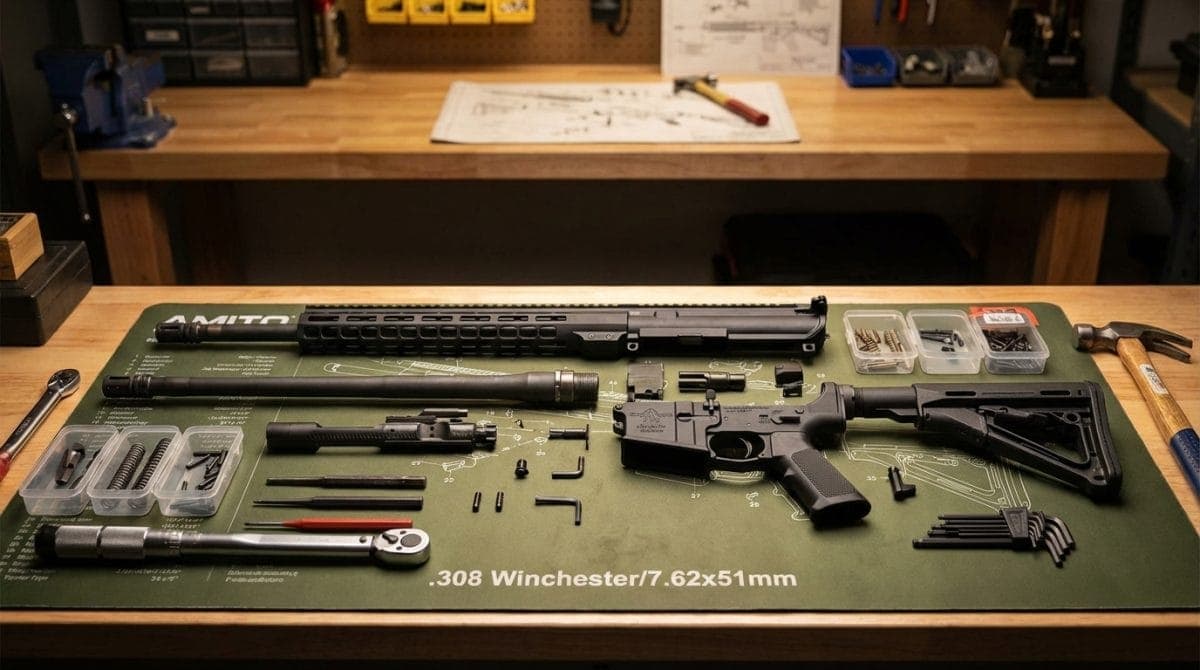
AR-10 Build Guide: Differences from AR-15
By AR-15 Outfitters · April 9, 2026
AR15 Outfitters may earn a commission on purchases made through links in this guide. This does not affect pricing or our recommendations.
Building an AR-10 presents unique challenges compared to its smaller AR-15 counterpart. While both platforms share similar operating principles, the AR-10 requires careful attention to compatibility issues, proprietary standards, and increased forces from the larger .308 Winchester/7.62×51 NATO cartridge. This guide covers the key differences you need to know before starting your AR-10 build.
Understanding AR-10 vs AR-15 Platform Differences
The AR-10 predates the AR-15, originally designed by Eugene Stoner in the 1950s for the 7.62×51 NATO cartridge. The AR-15 came later as a scaled-down version for the 5.56×45 NATO round. This size difference affects every component:
- Receiver dimensions: AR-10 receivers are approximately 1 inch longer and 0.25 inches wider than AR-15 receivers
- Weight increase: Complete AR-10 rifles typically weigh 8 to 11 pounds, compared to 6 to 8 pounds for AR-15 builds
- Recoil impulse: The .308 generates approximately 15 to 18 ft-lbs of recoil energy, compared to 4 to 5 ft-lbs for 5.56 NATO
- Magazine capacity: Standard AR-10 magazines hold 20 rounds vs 30 rounds for AR-15
AR-10 Pattern Compatibility Issues
Unlike the standardized AR-15 platform, AR-10 components come in two primary patterns that are NOT interchangeable:
DPMS/SR-25 Pattern (Most Common)
- Used by Aero Precision, Palmetto State Armory, most aftermarket manufacturers
- Rounded receiver profile
- DPMS High or Low rail height options
- Threaded bolt catch pin
ArmaLite Pattern
- Used by ArmaLite, some Knights Armament models
- Angled receiver cuts
- Proprietary magazine design
- Different bolt catch assembly
Important: Before purchasing any components, verify which pattern your build uses. Mixing patterns will result in non-functional firearms.
Complete AR-10 Parts List
Here’s what you need for a complete DPMS-pattern AR-10 build:
Lower Receiver Group
- AR-10 Lower Receiver (stripped or complete)
- Lower Parts Kit (LPK) specific to AR-10
- Buffer Tube Assembly (requires AR-10 specific buffer and spring)
- AR-10 Buffer (typically 3.8 to 5.4 oz vs 3.0 oz for AR-15)
- AR-10 Buffer Spring (higher spring rate than AR-15)
- Stock (most AR-15 stocks work)
- Pistol Grip (AR-15 grips are compatible)
- AR-10 Magazine
Upper Receiver Group
- AR-10 Upper Receiver (verify DPMS High or Low profile)
- AR-10 Barrel (.308 Winchester or 6.5 Creedmoor typical)
- AR-10 Bolt Carrier Group
- Charging Handle (AR-10 specific)
- Gas Block (.936″ typical for .308, vs .750″ for AR-15)
- Gas Tube (rifle length common for 18″+ barrels)
- Handguard (DPMS High or Low specific)
- Muzzle Device (5/8×24 thread pitch for .308)
Tools Required for AR-10 Assembly
Most AR-15 tools work for AR-10 builds, with these exceptions:
- AR-10 specific vise block: Larger dimensions require proper-fitting blocks
- Torque wrench: Higher torque specifications demand accuracy
- Barrel nut wrench: Must match your specific handguard system
- Go/No-Go gauges: In .308 Winchester or your chosen caliber
- Standard AR-15 tools that work: Punches, castle nut wrench, pivot pin tool
Step-by-Step AR-10 Assembly Instructions
Lower Receiver Assembly
Step 1: Install Magazine Catch
- Insert magazine catch through left side of receiver
- Thread magazine catch button from right side
- Depress button fully and rotate catch 8 to 10 full turns
- Test with AR-10 magazine for proper retention
Step 2: Install Bolt Catch
Note: DPMS pattern uses threaded pin, ArmaLite uses roll pin
- Insert spring and plunger into receiver pocket
- Align bolt catch and insert threaded pin
- Apply blue Loctite and torque to 30 to 40 inch-pounds
Step 3: Install Trigger Group
- Insert trigger spring with legs facing forward
- Install trigger and trigger pin
- Position hammer spring with legs on trigger pin
- Install hammer and hammer pin
- Function test: hammer should lock back when trigger pulled
Step 4: Install Safety Selector
- Insert detent and spring from bottom
- Install pistol grip to capture spring
- Rotate selector through receiver
- Test both safe and fire positions
Step 5: Install Buffer System
- Thread buffer tube into lower receiver
- Align for buffer retainer pin at 6 to 7 turns
- Insert buffer retainer and spring
- Install end plate and castle nut
- Torque castle nut to 38 to 42 ft-lbs
- Stake castle nut in two places
Upper Receiver Assembly
Step 6: Install Barrel
- Apply aeroshell grease to barrel extension
- Insert barrel into upper receiver
- Align gas port at 12 o’clock
- Install barrel nut hand tight
- Torque to manufacturer specification (typically 50 to 80 ft-lbs)
- Time for handguard alignment if required
Step 7: Install Gas System
- Slide gas block onto barrel (verify .936″ journal diameter)
- Insert gas tube into gas block
- Align gas tube with upper receiver port
- Secure gas block with set screws or taper pins
- Torque set screws to 30 to 35 inch-pounds with Loctite
Step 8: Install Handguard
Process varies by manufacturer. For free-float systems:
- Verify DPMS High or Low compatibility
- Install proprietary barrel nut if required
- Attach handguard per manufacturer instructions
- Torque mounting screws to specification (typically 25 to 35 inch-pounds)
Step 9: Install BCG and Charging Handle
- Pull charging handle partially back
- Insert bolt carrier group, bolt forward
- Push both fully into upper receiver
- Function test by cycling action
Final Assembly and Function Testing
- Mate upper and lower receivers with takedown pins
- Install .308 magazine (should drop free when empty)
- Perform function check:
- Safety selector blocks trigger in safe position
- Trigger releases hammer cleanly
- Charging handle cycles smoothly
- Bolt locks back on empty magazine
- Check headspace with Go/No-Go gauges before firing
Common AR-10 Build Mistakes to Avoid
1. Mixing DPMS and ArmaLite Patterns
This is the most common error. Components look similar but have different dimensions. Always verify compatibility before ordering.
2. Using AR-15 Lower Parts
While some parts interchange (pistol grip, safety, trigger), these AR-10 specific parts differ:
- Takedown pins (larger diameter: 0.315″ vs 0.250″)
- Bolt catch and plunger
- Magazine catch (some models)
- Buffer and spring
3. Incorrect Buffer Weight
AR-10 systems require heavier buffers. Using AR-15 buffers causes:
- Short stroking
- Failure to lock back on empty
- Excessive bolt velocity
Standard weights range from 3.8 oz (carbine) to 5.4 oz (rifle length).
4. Wrong Gas System Length
AR-10 barrels typically use:
- 16″ barrels: Mid-length gas system
- 18″ barrels: Rifle length gas system
- 20″+ barrels: Rifle length gas system
Carbine length systems on .308 create excessive port pressure and accelerated wear.
5. Incompatible Rail Heights
DPMS pattern comes in two rail heights:
- DPMS Low: Most common, used by Aero Precision M5
- DPMS High: Used by older DPMS rifles, some specialty manufacturers
Mixing rail heights prevents proper handguard alignment.
Torque Specifications Summary
| Component | Torque Specification | Notes |
|---|---|---|
| Barrel Nut | 50-80 ft-lbs | Check manufacturer spec |
| Castle Nut | 38-42 ft-lbs | Stake after torquing |
| Gas Block Set Screws | 30-35 in-lbs | Use Loctite |
| Bolt Catch (DPMS) | 30-40 in-lbs | Blue Loctite |
| Handguard Screws | 25-35 in-lbs | Varies by manufacturer |
| Scope Ring Screws | 15-20 in-lbs | Aluminum rings |
| Muzzle Device | 20-30 ft-lbs | Use shims or crush washer |
Caliber Considerations for AR-10 Builds
While .308 Winchester remains most popular, the AR-10 platform supports various calibers:
- .308 Winchester/7.62×51: Most common, widest ammunition selection
- 6.5 Creedmoor: Superior long-range ballistics, same bolt face
- .243 Winchester: Lower recoil varmint option
- .338 Federal: Increased power for hunting
- 6.5 Grendel: Some large-frame versions available
Most calibers share the same bolt face (0.473″), simplifying barrel swaps.
Build This on AR15 Outfitters
Ready to start your AR-10 build? The AR15 Outfitters Builder makes it easy to configure a compatible AR-10 with real-time pricing from multiple vendors. The builder automatically filters components by pattern compatibility, preventing common ordering mistakes.
Key features for AR-10 builders:
- DPMS vs ArmaLite pattern filtering
- Rail height compatibility checking
- Caliber-specific component selection
- Price comparison across major retailers
- Build list saving and sharing
Start with a lower receiver selection to establish your pattern, then the builder guides you through compatible components. Each part includes specifications, compatibility notes, and current pricing. Visit ar15outfitters.com/builder to begin configuring your AR-10 build today.
Disclaimer: AR15 Outfitters does not sell firearms. This site is an information and affiliate resource only. All purchases are completed through licensed retailers. Always comply with all federal, state, and local laws when building or purchasing firearms and firearm components.