
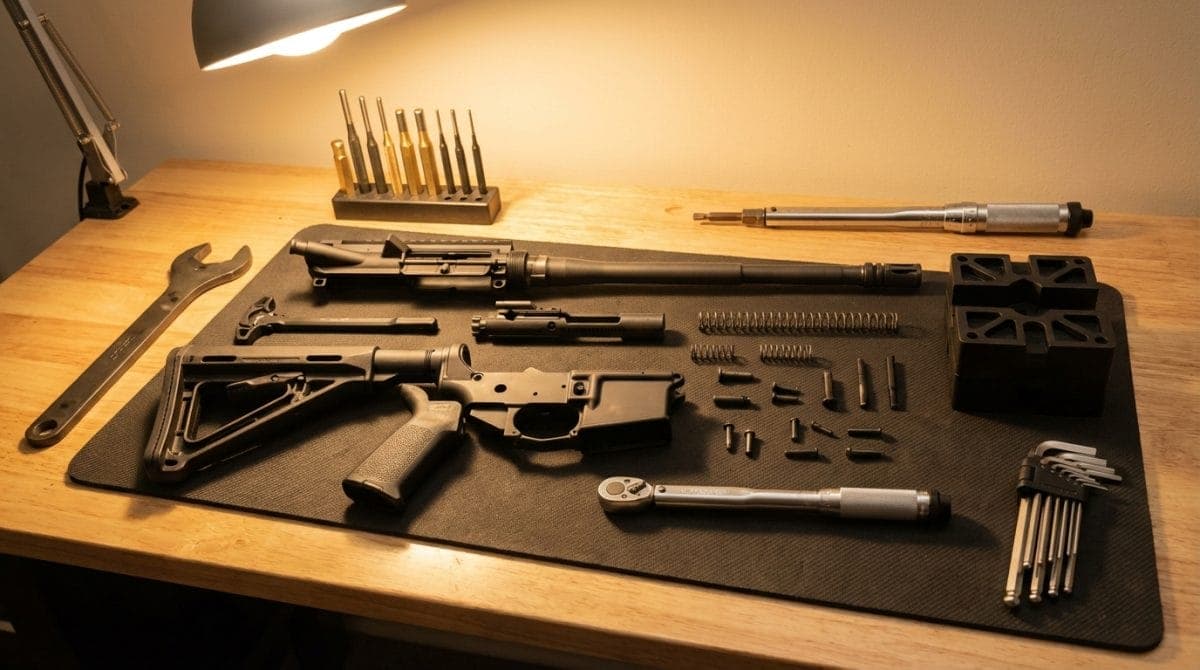
AR-15 Barrel Buying Guide: Caliber, Length, Twist Rate, and Profile
By AR-15 Outfitters · April 9, 2026
AR15 Outfitters may earn a commission on purchases made through links in this guide. This does not affect pricing or our recommendations.
Selecting the right barrel for your AR-15 build fundamentally determines your rifle’s performance characteristics. Your barrel choice affects accuracy, weight, handling, ammunition compatibility, and overall system reliability. This comprehensive AR-15 barrel guide covers caliber options, length considerations, twist rate selection, and profile choices to help you make an informed decision.
Understanding AR-15 Barrel Calibers
The AR-15 platform supports numerous calibers, but four stand out for their widespread adoption and proven performance. Each caliber serves different purposes and requires specific considerations for optimal performance.
5.56 NATO vs .223 Wylde
The 5.56 NATO chamber features a longer throat (leade) and operates at higher pressures than commercial .223 Remington. A 5.56 NATO chamber safely fires both 5.56 NATO and .223 Remington ammunition, though accuracy with .223 Remington may decrease slightly due to the longer jump to the rifling.
.223 Wylde chambers offer an optimized solution, featuring a throat design that accommodates both cartridges while maintaining match-grade accuracy potential. The .223 Wylde chamber typically delivers 0.5 to 1 MOA improvement over standard 5.56 NATO chambers when using quality ammunition.
.300 Blackout Performance
.300 Blackout barrels excel in short configurations, achieving optimal powder burn in 8 to 10 inch barrels. This caliber delivers approximately 16% more energy than 5.56 NATO from a 9-inch barrel: a 125-grain .300 Blackout produces roughly 1,360 ft-lbs at the muzzle versus 1,170 ft-lbs from a 77-grain 5.56 NATO.
The .300 Blackout uses standard AR-15 bolt carrier groups and magazines, requiring only a barrel change for conversion. Subsonic loads paired with suppressors create an exceptionally quiet platform for home defense or hunting applications.
6.5 Grendel Capabilities
6.5 Grendel barrels transform the AR-15 into a legitimate medium-range precision platform. This caliber maintains supersonic flight beyond 1,000 yards from an 18-inch barrel, compared to approximately 600 yards for 5.56 NATO. The 6.5 Grendel requires a Type 2 bolt with proper bolt face dimensions (0.441 inches) and dedicated magazines due to the larger case diameter.
Barrel Length Considerations for Your AR-15
Barrel length directly impacts velocity, gas system function, handling characteristics, and legal classification. Understanding these relationships helps you select the optimal length for your intended use.
Pistol Length Barrels: 7.5 to 11.5 Inches
Short barrels under 11.5 inches typically use pistol-length gas systems with a 4-inch gas port distance. A 10.5-inch 5.56 NATO barrel produces approximately 2,600 fps with 55-grain ammunition, sacrificing roughly 400 fps compared to a 16-inch barrel. These configurations require careful gas system tuning, often benefiting from adjustable gas blocks or heavier buffer systems.
The 7.5-inch barrel represents the practical minimum for 5.56 NATO, producing significant muzzle flash and concussion. These ultra-short barrels work better with .300 Blackout, which achieves complete powder burn by 9 inches.
Carbine and Mid-Length Options: 14.5 to 16 Inches
The 16-inch barrel remains the most popular choice, avoiding NFA regulations while providing solid ballistic performance. A 16-inch barrel with mid-length gas system offers approximately 7.1 inches of dwell time, promoting smoother cycling and reduced parts wear compared to carbine-length systems on the same barrel length.
The 14.5-inch barrel with permanently attached muzzle device reaching 16 inches total provides optimal handling for general-purpose rifles. This configuration typically produces 2,900 fps with 55-grain ammunition, sacrificing minimal velocity for improved maneuverability.
Rifle Length Barrels: 18 to 20 Inches
Longer barrels maximize velocity and extend effective range. An 18-inch barrel adds approximately 100 fps over a 16-inch barrel, while a 20-inch barrel provides another 50 to 75 fps. These lengths pair well with rifle-length gas systems, offering the smoothest recoil impulse and longest sight radius for iron sight use.
Twist Rate Selection and Bullet Stabilization
Twist rate determines which bullet weights your barrel stabilizes effectively. The relationship follows the Greenhill Formula, though modern bullets often perform well outside theoretical limits due to improved designs.
1:9 Twist Rate Applications
The 1:9 twist rate optimally stabilizes bullets from 45 to 69 grains. This twist rate struggles with heavier match bullets, particularly in cold weather where air density increases. A 1:9 barrel typically shoots 55 and 62-grain bullets most accurately, making it ideal for shooters using primarily M193 and M855 ammunition.
1:8 Twist Versatility
The 1:8 twist rate represents the best all-around choice for 5.56/.223 barrels. This rate stabilizes bullets from 55 to 77 grains effectively, with adequate performance down to 45 grains and up to 80 grains in most conditions. The 1:8 twist accommodates both affordable practice ammunition and premium match loads.
1:7 Twist for Heavy Bullets
Originally specified for M856 tracer rounds, the 1:7 twist rate handles bullets from 55 to 90 grains. This faster twist may over-stabilize lightweight varmint bullets, potentially causing accuracy degradation with 45 to 50-grain bullets. However, 1:7 barrels excel with 77-grain OTM and heavier match bullets, making them popular for precision and long-range applications.
Barrel Profile Selection
Barrel profile affects weight distribution, heat dissipation, and handling characteristics. Each profile represents a compromise between weight and sustained fire capability.
Government Profile Characteristics
The government profile features a 0.625-inch diameter behind the gas block and 0.750 inches forward. This design adds unnecessary weight forward of the gas block where stress is lowest. A 16-inch government profile barrel typically weighs 1.85 pounds, with suboptimal weight distribution for most civilian applications.
Lightweight and Pencil Profiles
Lightweight profiles maintain approximately 0.625-inch diameter throughout their length, reducing weight by 4 to 6 ounces compared to government profiles. Pencil barrels take this further, often measuring 0.560 inches under the handguards. A 16-inch pencil barrel weighs approximately 1.3 pounds, significantly improving handling but limiting sustained fire capability.
Heavy and Bull Barrel Advantages
Heavy barrels feature 0.750-inch or larger diameters throughout their length. Bull barrels typically measure 0.936 inches or larger. These profiles resist heat-induced point of impact shifts, maintaining accuracy through extended firing sessions. A heavy 16-inch barrel weighs approximately 2.5 pounds, best suited for precision or high-volume shooting from supported positions.
Barrel Materials and Treatments
Material selection and treatment affect barrel life, corrosion resistance, and accuracy potential. Understanding these options helps match your barrel to intended use and maintenance preferences.
4150 Chrome Moly Vanadium Steel
4150 CMV represents the military standard for AR-15 barrels. This material offers excellent strength and heat resistance, with typical barrel life exceeding 20,000 rounds for chrome-lined versions. The addition of vanadium improves grain structure and heat treatment response compared to standard 4140 steel.
416R Stainless Steel Benefits
416R stainless steel machines more precisely than chrome moly steels, often delivering superior accuracy potential. These barrels typically shoot 0.25 to 0.5 MOA better than equivalent chrome moly barrels. However, stainless barrels generally wear faster, with typical life spans of 10,000 to 15,000 rounds depending on firing schedule and ammunition.
Chrome Lining vs Nitride Treatment
Chrome lining adds 0.001 to 0.002 inches to bore dimensions, providing exceptional corrosion resistance and extending barrel life to 25,000 rounds or more. However, the lining process may introduce minor inconsistencies affecting ultimate accuracy potential.
Nitride treatment (also called melonite or QPQ) penetrates the steel surface, maintaining dimensional consistency while providing excellent corrosion resistance. Nitride-treated barrels typically deliver chrome-lined durability with stainless-like accuracy potential. The treatment also reduces friction, potentially increasing velocity by 25 to 50 fps.
Barrel Extension Compatibility
Barrel extensions must match your upper receiver and bolt specifications. The M4 extension remains standard for 5.56/.223 and .300 Blackout applications, while alternative calibers may require different patterns.
The M4 extension features specific feed ramp geometry matching standard upper receivers. Ensure your barrel extension and upper receiver feed ramps align properly: mismatched components cause feeding reliability issues. DPMS-pattern extensions apply primarily to large-frame AR-10 style rifles and certain alternative AR-15 calibers.
Matching Barrels to Build Purpose
Your intended use should drive barrel selection. Consider these configurations for common applications:
Home Defense Builds
Home defense rifles benefit from short, maneuverable barrels with reliable function. A 10.5 to 11.5-inch .300 Blackout barrel or 11.5 to 12.5-inch 5.56 NATO barrel provides adequate terminal performance while maintaining compact dimensions. Choose chrome-lined or nitride-treated barrels for corrosion resistance with minimal maintenance. Lightweight profiles work well since sustained fire is unlikely.
Precision Rifle Configurations
Precision builds demand heavy contour barrels in 18 to 20-inch lengths. Select .223 Wylde chambers with 1:7 or 1:8 twist rates for versatility with match ammunition. Stainless steel or nitride-treated barrels typically deliver the best accuracy. Consider 6.5 Grendel for extended range requirements beyond 600 yards.
General Purpose Rifles
All-around builds benefit from 14.5 to 16-inch barrels with mid-length gas systems. Choose 1:8 twist rates in 5.56 NATO or .223 Wylde chambers for ammunition flexibility. Government or lightweight profiles balance weight and heat dissipation for typical use. Nitride treatment provides the best combination of accuracy, durability, and value.
Recommended Parts
Building your AR-15 requires careful parts selection beyond just the barrel. The AR15 Outfitters Builder simplifies this process by ensuring compatibility while comparing prices across multiple retailers.
Essential Barrel Components
Start your build by selecting a quality barrel matched to your intended purpose. The builder tool helps you filter barrels by caliber, length, profile, and treatment options. Once you’ve selected your barrel, you’ll need compatible components:
- Gas blocks must match your barrel’s journal diameter (typically 0.625, 0.750, or 0.875 inches)
- Gas tubes correspond to your gas system length (pistol, carbine, mid-length, or rifle)
- Muzzle devices require correct thread pitch (typically 1/2×28 for .223/5.56 or 5/8×24 for .30 caliber)
- Handguards must accommodate your gas block style and extend appropriately for your barrel length
Complete Upper Assembly Components
Your barrel choice influences several other component selections. Use the AR15 Outfitters Builder to ensure compatibility:
- Upper receivers with proper feed ramp configuration for your barrel extension
- Bolt carrier groups with correct bolt face for your caliber
- Charging handles sized appropriately for your upper receiver
- Handguards that provide adequate barrel nut clearance and gas system compatibility
Supporting Components
Don’t forget these important parts that work with your barrel selection:
- Adjustable gas blocks for tuning short barrels or suppressed configurations
- Enhanced buffer systems for reliable function with various barrel lengths
- Quality triggers to maximize your barrel’s accuracy potential
- Appropriate stocks and grips for your rifle’s intended role
The AR15 Outfitters Builder automatically checks compatibility between components, preventing costly mistakes while helping you find the best prices across trusted retailers. Whether building a precision rifle, home defense gun, or general-purpose AR-15, the builder ensures your barrel and supporting components work together properly.
Disclaimer: AR15 Outfitters does not sell firearms. This site is an information and affiliate resource only. All purchases are completed through licensed retailers. Always comply with all federal, state, and local laws when building or purchasing firearms and firearm components.