
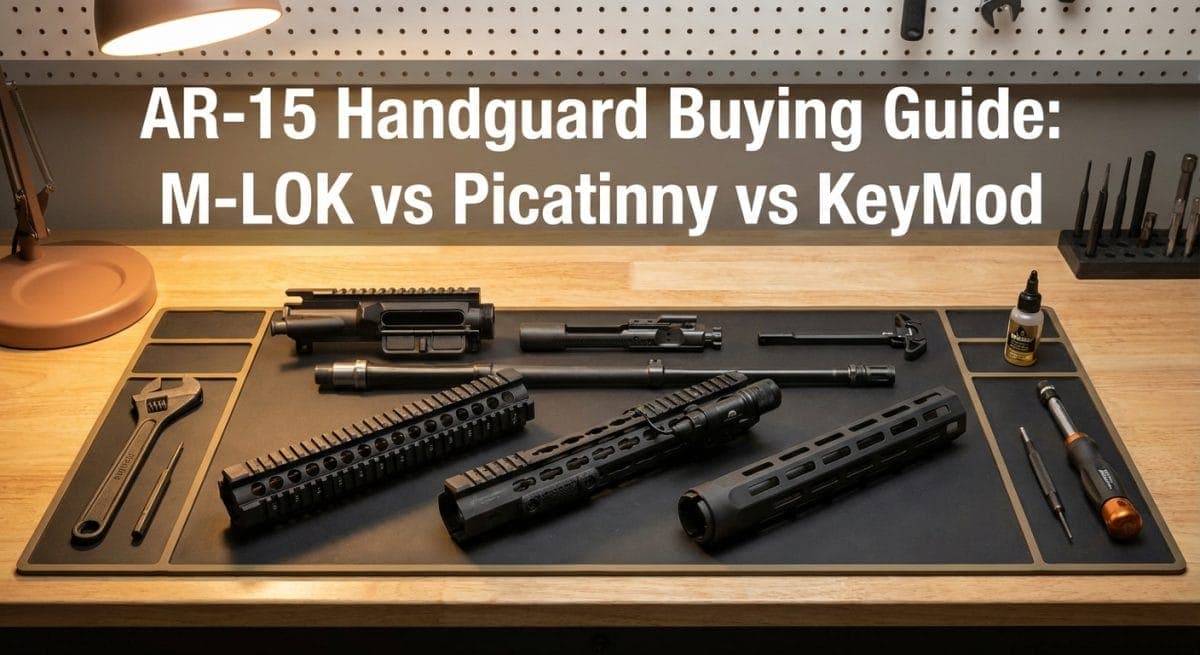
AR-15 Handguard Buying Guide: M-LOK vs Picatinny vs KeyMod
By AR-15 Outfitters · April 9, 2026
AR15 Outfitters may earn a commission on purchases made through links in this guide. This does not affect pricing or our recommendations.
Selecting the right handguard for your AR-15 build involves balancing attachment system preferences, weight considerations, and compatibility requirements. The handguard serves as your primary interface with the rifle and mounting platform for accessories, making it one of the most important decisions in your build process.
Understanding Attachment Systems: M-LOK vs Picatinny vs KeyMod
The three primary attachment systems each offer distinct advantages for mounting accessories like lights, grips, and slings. Understanding their differences helps you choose the system that best fits your shooting style and equipment needs.
M-LOK (Modular Lock)
M-LOK has become the dominant attachment system in both civilian and military markets. Developed by Magpul and released as an open-source standard in 2014, M-LOK uses elongated slots with a bi-directional recoil lug system.
Key specifications for M-LOK include:
- Slot dimensions: 1.26 inches long by 0.32 inches wide
- T-nut torque specification: 15 inch-pounds maximum
- Slot spacing: typically 1.5 inches center-to-center
- Weight savings: approximately 30% lighter than equivalent Picatinny rail coverage
M-LOK accessories lock into place using T-nuts that rotate 90 degrees behind the handguard wall. This system distributes recoil forces across a larger surface area compared to KeyMod, resulting in better long-term retention under heavy use.
Picatinny Quad Rails
The Picatinny rail system (MIL-STD-1913) remains popular for its proven reliability and universal compatibility. Quad rail handguards feature continuous rails at the 12, 3, 6, and 9 o’clock positions.
Picatinny specifications include:
- Slot width: 0.206 inches
- Slot spacing: 0.394 inches center-to-center
- Cross-slot (recoil groove) spacing: 0.617 inches
- Rail height above receiver: 0.5 inches standard
While heavier than modular systems, Picatinny rails offer unmatched accessory compatibility. Every AR-15 accessory manufacturer produces Picatinny-compatible products, ensuring you’ll never struggle to find mounting solutions.
KeyMod
KeyMod, developed by VLTOR and released in 2012, uses keyhole-shaped slots for accessory attachment. While innovative at launch, KeyMod has largely been superseded by M-LOK in new handguard designs.
KeyMod specifications:
- Slot length: 1.39 inches
- Narrow opening: 0.216 inches
- Wide opening: 0.315 inches diameter
- Mounting hardware typically torqued to 15-20 inch-pounds
In 2017 SOCOM testing, M-LOK demonstrated superior drop test performance and repeatability compared to KeyMod, accelerating the market shift toward M-LOK. However, KeyMod handguards remain viable options, particularly when found at discounted prices.
Free-Float vs Drop-In Handguards
The choice between free-float and drop-in handguards significantly impacts both installation complexity and potential accuracy.
Free-Float Handguards
Free-float handguards attach only to the barrel nut, eliminating contact with the barrel. This design prevents handguard pressure from affecting barrel harmonics, typically improving accuracy by 0.25 to 1.0 MOA depending on the rifle and shooter.
Installation requirements for free-float handguards:
- Barrel nut torque: typically 30-80 ft-lbs (varies by manufacturer)
- Upper receiver vice blocks required
- Removal of existing front sight base/gas block
- Low-profile gas block installation
- Proper timing for anti-rotation features
Free-float systems excel when using bipods, slings, or vertical grips. With a drop-in handguard, pressure from these accessories can shift point of impact. Free-float designs eliminate this variable, maintaining consistent zero regardless of accessory loading.
Drop-In Handguards
Drop-in handguards use the traditional delta ring and handguard cap system, making them ideal for beginners or those maintaining mil-spec configurations. Installation takes minutes with basic tools.
Drop-in handguard characteristics:
- Compatible with standard front sight bases
- No barrel nut changes required
- Typical weight: 6-10 ounces for polymer models
- Limited to carbine, mid-length, or rifle lengths matching gas system
Barrel Nut Compatibility Considerations
Most free-float handguards include proprietary barrel nuts, requiring attention to upper receiver compatibility. Standard AR-15 upper receivers accommodate barrel nuts up to 1.35 inches in diameter, though some enhanced designs allow up to 1.5 inches.
Common barrel nut systems include:
- Standard GI pattern: Compatible with most handguards, torqued to 30-80 ft-lbs
- BAR pattern: Used by Aero Precision and others, requires timing for gas tube alignment
- Proprietary enhanced: Often feature anti-rotation tabs requiring matched upper receivers
When building, verify your chosen handguard’s barrel nut diameter and attachment method. Some systems like the BCM MCMR use a two-piece design allowing barrel nut installation without removing muzzle devices, simplifying builds and maintenance.
Handguard Length Selection
Proper handguard length depends on your barrel length, gas system, and intended use. The relationship between these components affects both functionality and aesthetics.
Gas System Coverage
For optimal heat management, select handguards that extend past your gas block:
- Carbine gas (7 inches): 7-inch or longer handguards
- Mid-length gas (9 inches): 9-inch or longer handguards
- Rifle gas (12 inches): 12-inch or longer handguards
Barrel Length Considerations
Maximum handguard length depends on barrel length and muzzle device timing:
- 16-inch barrels: Up to 15-inch handguards (with standard muzzle devices)
- 14.5-inch barrels (pinned): 13.5-inch maximum typically
- 18-inch barrels: Up to 15-inch handguards common
- 20-inch barrels: 15-inch or rifle-length options
Leave at least 0.5 inches between handguard end and muzzle device for proper clearance. Suppressor users should maintain 1.5 inches minimum to accommodate mounting systems.
Material Options and Weight Considerations
Handguard materials significantly impact rifle balance, heat dissipation, and durability. Modern options range from traditional aluminum to advanced composites.
Aluminum Handguards
6061-T6 aluminum remains the standard for AR-15 handguards, offering excellent strength-to-weight ratios:
- Typical weight: 7-14 ounces for 13-15 inch models
- Wall thickness: 0.06-0.125 inches typically
- Heat conductivity: 167 W/m·K (excellent heat dissipation)
- Cost: $75-300 depending on features
Premium manufacturers often use 7075-T6 aluminum for added strength, though the weight difference proves negligible in handguard applications.
Polymer Handguards
Glass-filled polymer handguards provide weight savings and reduced heat transfer:
- Weight reduction: typically 30-40% versus aluminum
- Heat conductivity: 0.2-0.5 W/m·K (stays cooler to touch)
- Temperature rating: usually 300-400°F continuous
- Cost: $40-150 generally
While lighter, polymer handguards offer less rigidity for precision shooting applications. They excel for lightweight builds where extreme accuracy isn’t paramount.
Carbon Fiber Handguards
Carbon fiber represents the premium option for weight-conscious builders:
- Weight: 4-8 ounces for full-length models
- Stiffness: superior to aluminum by weight
- Heat conductivity: 5-10 W/m·K (moderate)
- Cost: $200-500 typically
Carbon fiber handguards require careful installation to prevent cracking. Follow manufacturer torque specifications exactly, typically 15-20 inch-pounds for mounting hardware.
Heat Dissipation and Thermal Management
During rapid fire, barrel temperatures can exceed 600°F, making heat dissipation a critical handguard function. Design features that improve cooling include:
- Ventilation slots: More openings generally mean better airflow
- Internal diameter: Larger IDs (1.5 inches+) improve convection
- Heat shields: Some models include thermal barriers
- Surface treatments: Anodizing and cerakote can improve heat radiation
M-LOK and KeyMod systems inherently provide better ventilation than quad rails due to their extensive slot patterns. In sustained fire testing, slotted handguards typically run 50-100°F cooler than equivalent quad rails.
Installation Best Practices
Proper installation ensures reliability and maintains accuracy potential:
- Barrel nut installation: Use proper barrel nut grease (Aeroshell 33MS or equivalent)
- Torque sequence: 30 ft-lbs, loosen, 30 ft-lbs, then final torque per manufacturer
- Timing marks: Align gas tube holes within 2 degrees
- Anti-rotation: Ensure positive engagement of anti-rotation features
- Accessory mounting: Follow specified torque values to prevent crushing
Recommended Parts
When selecting your AR-15 handguard, the AR15 Outfitters Builder provides comprehensive filtering options to match handguards with your specific upper receiver, barrel length, and gas system configuration.
For M-LOK builds, start by browsing the handguard category filtered by your barrel length. The builder automatically shows compatible options based on your selected components, preventing fitment issues common with mismatched parts.
Key considerations when using the builder:
- Select your upper receiver first to ensure barrel nut compatibility
- Choose your barrel and gas block to determine minimum handguard length
- Filter by attachment system (M-LOK, Picatinny, or KeyMod)
- Compare weights to optimize your build’s balance point
- Check included hardware: some handguards include barrel nuts and mounting hardware
For budget-conscious builders, the AR15 Outfitters Builder excels at finding value options. Sort by price within your preferred attachment system to identify quality handguards from reputable manufacturers at competitive prices. Many builders find excellent M-LOK options from Aero Precision, Midwest Industries, and Anderson Manufacturing offering 80% of premium features at half the cost.
Remember to factor in additional components when budgeting: low-profile gas blocks, barrel nut shims, and proper tools for installation. The builder’s compatibility checking helps ensure all components work together, preventing costly mistakes during assembly.
Disclaimer: AR15 Outfitters does not sell firearms. This site is an information and affiliate resource only. All purchases are completed through licensed retailers. Always comply with all federal, state, and local laws when building or purchasing firearms and firearm components.