
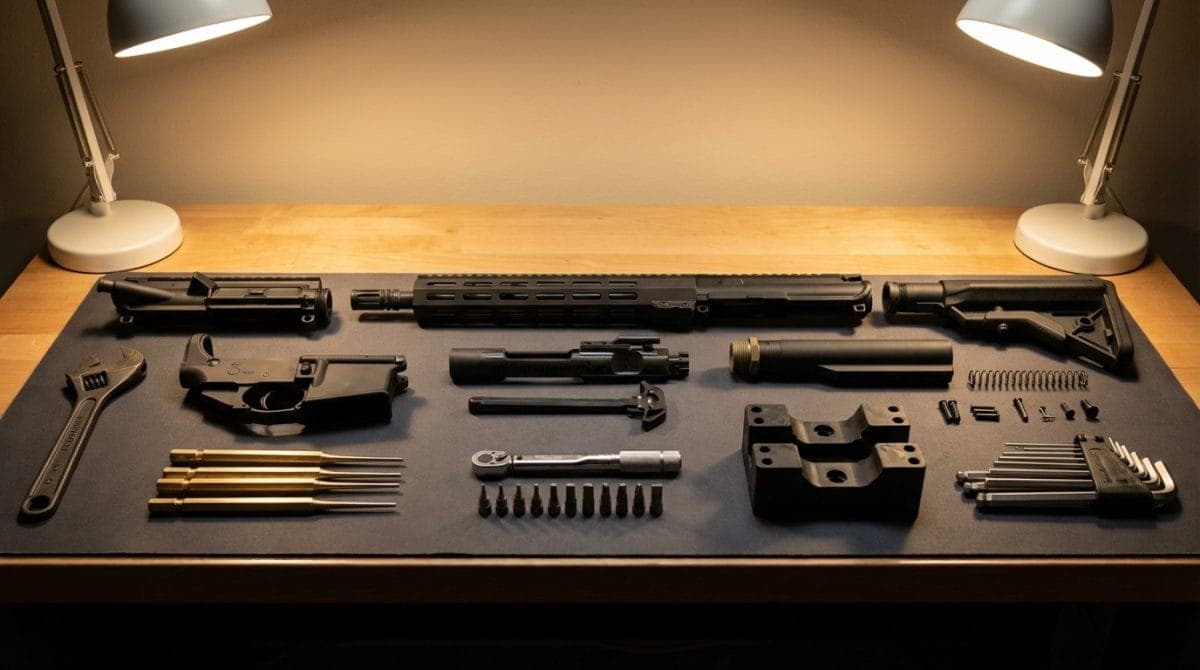
AR-15 Muzzle Device Guide: Flash Hiders, Brakes, and Compensators
By AR-15 Outfitters · April 9, 2026
AR15 Outfitters may earn a commission on purchases made through links in this guide. This does not affect pricing or our recommendations.
Selecting the right muzzle device for your AR-15 build can significantly impact your shooting experience. Whether you’re building for home defense, competition, or recreational shooting, understanding the differences between flash hiders, muzzle brakes, and compensators will help you make an informed decision that matches your specific needs.
Understanding AR-15 Muzzle Device Types
The three primary categories of AR-15 muzzle devices each serve distinct purposes. While some shooters default to whatever comes standard, choosing the right device for your application can improve accuracy, reduce fatigue, and enhance overall shooting performance.
Flash Hiders: Reducing Visual Signature
Flash hiders work by rapidly cooling and dispersing burning powder gases as they exit the barrel. The standard A2 flash hider, for example, features five slots that break up the expanding gas ball, typically reducing visible muzzle flash by 70-80% compared to a bare muzzle.
Common flash hider designs include:
- A2/A1 Bird Cage: The military standard, featuring either open (A1) or closed (A2) bottom design
- Three-Prong: Efficient flash suppression but prone to snagging on gear
- Four-Prong: Balanced design offering good flash reduction with less snagging
- Linear Flash Suppressors: Direct flash forward rather than dispersing it
Flash hiders typically add 2-2.5 inches to your barrel length and weigh between 1-3 ounces. They’re ideal for home defense builds where preserving night vision and minimizing signature matter more than recoil reduction.
Muzzle Brakes: Maximizing Recoil Reduction
Muzzle brakes redirect propellant gases to counteract recoil forces. By directing gas through side ports or chambers, they can reduce felt recoil by 40-60% on a standard 5.56 AR-15. This reduction allows faster follow-up shots and reduced shooter fatigue during extended range sessions.
Key muzzle brake characteristics include:
- Port design: Side ports, top ports, or radial ports
- Number of baffles: Typically 1-3 expansion chambers
- Port angle: Generally 90-135 degrees from bore axis
- Weight: Usually 2-5 ounces depending on material and design
The tradeoff with muzzle brakes is increased noise and concussion, particularly for shooters positioned to either side. Sound pressure levels can increase by 5-10 dB compared to flash hiders, making them less suitable for indoor ranges or team shooting scenarios.
Compensators: Controlling Muzzle Rise
Compensators specifically address muzzle rise by venting gases upward, pushing the muzzle down during recoil. This design helps maintain sight picture between shots, particularly beneficial for competition shooters requiring fast, accurate follow-up shots.
Effective compensator designs typically feature:
- Top ports angled 15-30 degrees forward
- Side ports for additional recoil reduction
- Expansion chambers to increase gas redirection efficiency
- Weight distribution favoring the top of the device
Testing shows quality compensators can reduce muzzle rise by 50-70% compared to bare muzzle configurations, though effectiveness varies with ammunition, barrel length, and gas system configuration.
Hybrid and Specialized Muzzle Devices
Combination Devices
Many modern AR-15 muzzle devices combine features from multiple categories. A flash hiding compensator, for instance, might feature top ports for muzzle rise control with prongs or ports designed to disrupt muzzle flash. These hybrids typically compromise some effectiveness in each area to provide balanced performance.
Popular hybrid configurations include:
- Flash hider/compensator: Reduces both flash and muzzle rise
- Brake/compensator: Maximum recoil reduction with muzzle control
- Three-way devices: Attempt all three functions with moderate success
Blast Forwarding Devices
Blast forwarding devices, sometimes called linear compensators or blast cans, direct all muzzle blast forward and away from the shooter. While they don’t reduce recoil or flash significantly, they excel at:
- Reducing perceived concussion for the shooter
- Protecting shooting partners from side blast
- Improving comfort when shooting under covered firing lines
- Reducing noise signature to the rear and sides
These devices typically measure 3-5 inches long and can add 3-6 ounces to your build. They’re particularly popular on short-barreled AR-15 builds where muzzle blast is more pronounced.
Suppressor-Mount Muzzle Devices
Quick-detach suppressor systems rely on specific muzzle devices as mounting points. These devices serve dual purposes: functioning as standalone muzzle devices when the suppressor isn’t attached, and providing a secure, repeatable mounting system for the suppressor.
Common suppressor mounting systems include:
- Direct thread mounts: Suppressor threads directly onto muzzle device
- Quick-detach ratchet systems: Tool-free attachment with positive lock
- Taper mounts: Precision taper ensures consistent alignment
- Gate-lock systems: Spring-loaded gates secure suppressor in place
When selecting suppressor-compatible muzzle devices, verify compatibility with your specific suppressor model. Thread pitch, shoulder dimensions, and mounting system must match exactly for safe operation.
Thread Patterns and Compatibility
Understanding thread patterns is essential for AR-15 muzzle device selection. The wrong thread pattern won’t just fail to install; attempting to force incompatible threads can damage both barrel and device.
Standard Thread Patterns by Caliber
For 5.56/.223 AR-15 barrels:
- 1/2×28 TPI: Industry standard for .223/5.56 NATO
- Minimum barrel thickness at threads: 0.625 inches
- Thread relief typically 0.05-0.08 inches
- Shoulder provides timing reference for non-symmetric devices
For .308/7.62 AR-15 pattern rifles:
- 5/8×24 TPI: Standard for .308 Winchester/7.62 NATO
- Larger thread diameter accommodates bigger bore
- Minimum barrel thickness at threads: 0.750 inches
- Not interchangeable with 5.56 devices despite similar TPI
Other common AR-15 caliber thread patterns:
- 9mm: Typically 1/2×28 or 1/2×36
- .300 Blackout: Uses 5/8×24 threads
- 6.5 Grendel: Usually 5/8×24
- 6.8 SPC: Generally 5/8×24
Installation Considerations
Proper muzzle device installation requires attention to several factors:
Timing: Devices with ports or asymmetric features must be properly oriented. This typically requires:
- Crush washers for one-time installation (torque to 30 ft-lbs)
- Peel washers for repeatable timing
- Shims for precision alignment (sets typically include 0.001-0.020 inch thickness)
- Locking compounds when appropriate (Rocksett for high-temperature applications)
Barrel shoulder: The muzzle device must seat squarely against the barrel shoulder. Gaps can cause:
- Gas leakage affecting device performance
- Misalignment potentially causing baffle strikes
- Loosening during use
Legal Considerations for Muzzle Devices
Muzzle device selection must account for local and state regulations, which vary significantly across jurisdictions. Some states classify certain muzzle devices as prohibited features on semi-automatic rifles.
Common Legal Restrictions
Several states restrict muzzle devices on semi-automatic rifles with detachable magazines:
- Flash hiders: Specifically named in some assault weapon definitions
- Threaded barrels: The ability to accept muzzle devices may be restricted
- Permanently attached devices: Some jurisdictions require pinning and welding
Important compliance considerations:
- Muzzle brakes and compensators are typically not restricted features
- Thread protectors don’t generally count as muzzle devices
- Pinned and welded devices count toward barrel length for NFA purposes
- Some states have specific lists of prohibited devices by name or model
Always verify current laws in your jurisdiction before purchasing or installing muzzle devices. Laws change frequently, and this information should not be considered legal advice.
Selecting the Right Muzzle Device for Your Build
Choosing between flash hiders, brakes, and compensators depends on your primary use case, shooting environment, and personal preferences.
Home Defense Builds
For home defense AR-15 configurations, prioritize:
- Flash suppression: Preserves night vision in low-light encounters
- Moderate sound levels: Reduces disorientation in confined spaces
- Compact length: Maintains maneuverability
Recommended device type: Flash hider or linear compensator, 2-3 inches length maximum
Competition Builds
Competition shooters typically benefit from:
- Maximum recoil reduction: Faster split times between shots
- Muzzle rise control: Maintains sight picture for transitions
- Consistent performance: Repeatable gas redirection
Recommended device type: Aggressive brake/compensator hybrid, weight not a primary concern
Precision Rifle Builds
Long-range precision shooting demands:
- Minimal point-of-impact shift: Consistent barrel harmonics
- Recoil reduction: Maintains scope picture for follow-up shots
- No accuracy degradation: Quality machining and concentric bore
Recommended device type: Precision muzzle brake or suppressor-ready device
General Purpose Builds
All-around AR-15 builds benefit from balanced performance:
- Moderate flash reduction: Useful without being specialized
- Some recoil mitigation: Improves comfort without excessive blast
- Versatile design: Performs adequately in various scenarios
Recommended device type: Hybrid flash hider/compensator or three-prong flash hider
Performance Testing and Evaluation
When evaluating muzzle device performance, consider these measurable factors:
Recoil reduction: Measured by:
- Felt recoil impulse (typically 40-60% reduction with quality brakes)
- Muzzle movement in high-speed video analysis
- Split times between aimed shots
- Shooter fatigue over extended sessions
Flash suppression: Evaluated through:
- Low-light photography comparisons
- Visible signature from multiple angles
- Performance with various ammunition types
- Effectiveness across different barrel lengths
Sound and concussion: Measured using:
- Decibel meters at shooter’s ear and 90-degree positions
- Perceived concussion and blast direction
- Impact on nearby shooters
- Indoor versus outdoor performance differences
Installation Best Practices
Proper installation ensures optimal performance and safety:
- Clean threads thoroughly: Remove any oil, debris, or thread locker residue
- Check thread engagement: Minimum 3-4 full rotations for secure mounting
- Use appropriate timing method: Crush washer, shims, or timing nut as designed
- Apply proper torque: Typically 20-30 ft-lbs unless otherwise specified
- Verify concentricity: Ensure bore alignment, especially for suppressor mounts
- Test for security: Check tightness after initial range session
Maintenance and Care
AR-15 muzzle devices require minimal but important maintenance:
- Regular cleaning: Carbon buildup affects performance, especially in brake ports
- Inspection schedule: Check for loosening, erosion, or damage every 500-1000 rounds
- Copper fouling: Can accumulate in brake chambers and affect gas flow
- Thread maintenance: Keep clean and lightly oiled when device is removed
Recommended Parts
When building your AR-15, selecting the right muzzle device requires considering your entire build configuration. The AR15 Outfitters Builder makes it easy to compare different muzzle devices while ensuring compatibility with your barrel’s thread pattern.
Start by selecting your barrel in the builder, which will automatically filter compatible muzzle devices based on thread pattern. You can then compare features, weights, and prices across different manufacturers to find the perfect match for your build’s purpose.
Key muzzle device categories available through the builder include:
- Flash hiders: From basic A2 styles to advanced multi-prong designs
- Muzzle brakes: Various port configurations for maximum recoil reduction
- Compensators: Specialized designs for competition and precision shooting
- Hybrid devices: Combining multiple functions in one package
- Suppressor m
Disclaimer: AR15 Outfitters does not sell firearms. This site is an information and affiliate resource only. All purchases are completed through licensed retailers. Always comply with all federal, state, and local laws when building or purchasing firearms and firearm components.