
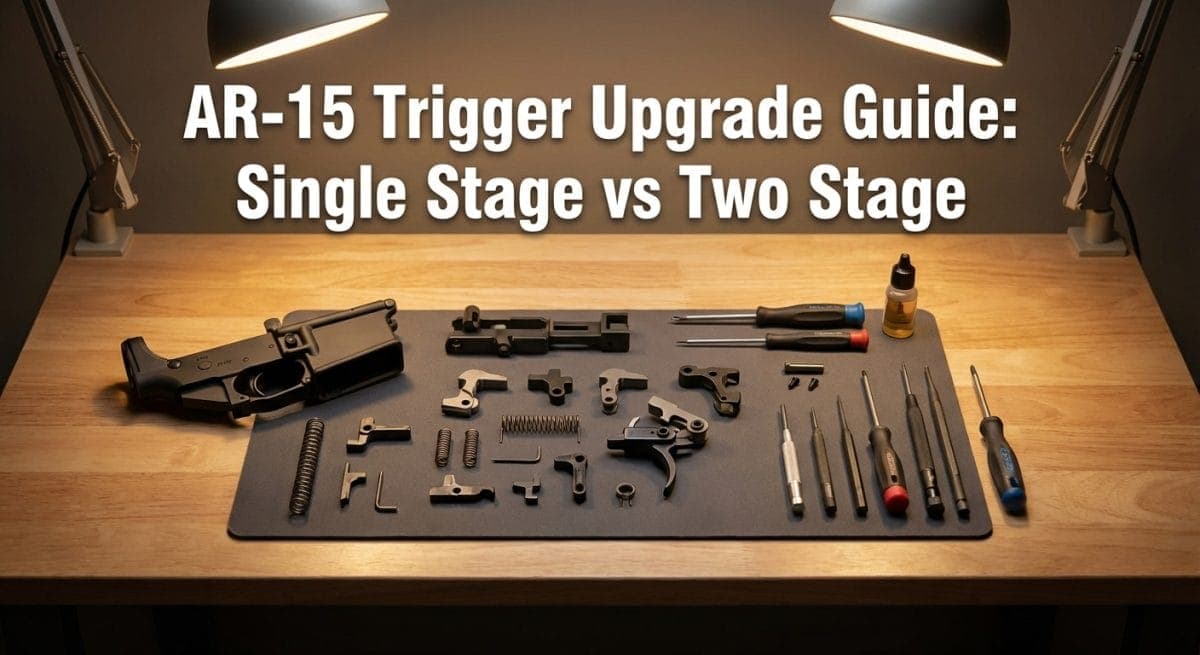
AR-15 Trigger Upgrade Guide: Single Stage vs Two Stage
By AR-15 Outfitters · April 9, 2026
AR15 Outfitters may earn a commission on purchases made through links in this guide. This does not affect pricing or our recommendations.
When it comes to AR-15 trigger upgrade single stage vs two stage decisions, understanding the fundamental differences between trigger types can transform your shooting experience. Whether you’re building your first AR-15 or upgrading an existing rifle, selecting the right trigger impacts everything from accuracy to speed.
Understanding AR-15 Trigger Basics
The AR-15 trigger mechanism consists of several key components: the trigger itself, hammer, disconnector, trigger and hammer pins, and springs. These parts work together to release the hammer, which strikes the firing pin to discharge the round. In a standard mil-spec configuration, these components are individual pieces that require proper assembly and timing.
Pull weight, measured in pounds of force required to release the hammer, typically ranges from 4.5 to 9 pounds for mil-spec triggers. Competition triggers often reduce this to 2.5 to 4 pounds, while precision triggers may go as low as 1.5 pounds, though most shooters find 2.5 to 3.5 pounds optimal for safety and control.
Reset characteristics determine how far forward the trigger must travel after firing before it can fire again. A shorter reset typically allows faster follow-up shots. Mil-spec triggers generally have a reset distance of 0.15 to 0.20 inches, while performance triggers can reduce this to 0.05 to 0.10 inches.
Single-Stage vs Two-Stage Triggers: Core Differences
A single stage trigger has one consistent pull weight from initial contact to hammer release. When you apply 4 pounds of pressure to a 4-pound single stage trigger, the hammer releases immediately. This design offers simplicity and speed, making it popular for competition and defensive applications.
Two stage triggers divide the pull into two distinct phases. The first stage typically requires 2 to 3 pounds of pressure and involves taking up slack or “preloading” the trigger. The second stage, often called the “break,” requires an additional 1 to 2 pounds of pressure. For example, a trigger marked “3.5 lb two-stage” might have a 2-pound first stage and a 1.5-pound second stage.
The tactile feedback between stages, called the “wall,” lets shooters prepare for the exact moment of firing. This predictability makes two stage designs excellent for precision shooting where you might hold at the wall while waiting for perfect sight alignment or breathing rhythm.
Measuring and Understanding Pull Weights
Pull weight measurements use a trigger pull gauge, which records the maximum force applied before release. When testing, mount the rifle securely and pull the gauge straight back at the center of the trigger face, approximately 0.25 inches from the bottom.
For single stage triggers, you’ll see one peak measurement. For two stage triggers, you’ll observe an initial rise to the first stage weight, a plateau as you move through the first stage travel (typically 0.10 to 0.15 inches), then a final rise to total pull weight at the break.
Trigger Materials and Construction Types
Mil-Spec Triggers
Military specification triggers use investment-cast 8620 steel components with a phosphate finish. These parts prioritize reliability and durability over smoothness. The surfaces are deliberately left somewhat rough to ensure function in adverse conditions. Mil-spec triggers typically exhibit 5.5 to 9.5 pounds of pull weight with noticeable grit and creep.
The hammer spring in mil-spec assemblies generates approximately 35 to 40 pounds of force, ensuring reliable primer ignition even with hard military primers or in cold conditions. This robust spring tension contributes to the heavier pull weight but enhances reliability.
Drop-In Cassette Triggers
Drop-in triggers contain all components in a self-contained housing, typically machined from 6061-T6 aluminum or steel. This design eliminates timing issues and simplifies installation. The housing maintains precise component alignment, resulting in consistently smoother operation.
Premium drop-in units often feature tool steel or S7 steel components, heat-treated to Rockwell 58-60 hardness. Some use EDM (Electrical Discharge Machining) wire cutting for surface finishes measured in micro-inches, creating glass-smooth engagement surfaces. These refined surfaces, combined with precise tolerances (often +/- 0.001 inches), deliver the crisp breaks and minimal overtravel that define high-end triggers.
Popular Trigger Types for Different Applications
Duty and Reliability: Enhanced Mil-Spec
For duty use, reliability trumps all other considerations. Enhanced mil-spec triggers maintain the robust spring weights and generous tolerances of standard mil-spec designs while improving surface finish and geometry. Typical specifications include:
- Pull weight: 4.5 to 6.5 pounds
- Minimal take-up: 0.05 to 0.10 inches
- Positive reset with audible/tactile confirmation
- Nickel-boron or similar corrosion-resistant coating
These triggers often polish contact surfaces while maintaining mil-spec geometry, providing smoother operation without compromising reliability. The ALG Defense ACT (Advanced Combat Trigger) exemplifies this approach, using the same springs as mil-spec but with refined sear geometry.
Competition: Single-Stage Flat Triggers
Competition shooters typically prefer single stage flat-face triggers for several reasons. The flat face provides consistent finger placement regardless of hand size or shooting position. Pull weights generally range from 2.5 to 4 pounds, balancing speed with safety.
The flat trigger face positions the finger at a more advantageous angle, reducing the perceived pull weight by approximately 10 to 15 percent compared to curved triggers. Combined with minimal take-up (typically under 0.020 inches) and short reset (0.030 to 0.050 inches), these characteristics enable rapid, accurate strings of fire.
Popular competition models achieve these specifications through precision manufacturing tolerances of +/- 0.0005 inches on critical surfaces, specialized sear geometry with engagement angles between 85 and 90 degrees, and reduced-power springs calibrated for reliability with match ammunition.
Precision: Two-Stage Triggers
Precision shooters generally favor two stage triggers for their predictability. A typical precision trigger might feature a 2-pound first stage with 0.125 inches of travel, followed by a 1 to 1.5-pound second stage break. This configuration allows shooters to preload the trigger while finalizing sight picture and respiratory pause.
Quality two stage triggers maintain consistent stage weights within +/- 2 ounces across thousands of cycles. The transition from first to second stage should feel like hitting a solid wall, with no creep or movement at the wall position. Break should be crisp, with overtravel limited to 0.010 to 0.020 inches.
Installation Process: Mil-Spec Triggers
Installing mil-spec AR-15 trigger components requires attention to detail and proper tools. You’ll need a hammer pin punch (5/32 inch), hammer, needle-nose pliers, and safety glasses. Always verify the firearm is completely unloaded before beginning.
Step-by-Step Mil-Spec Installation
1. Remove existing trigger group by driving out hammer and trigger pins from left to right using a 5/32-inch punch. Support the receiver to prevent damage.
2. Install the trigger first. Place the trigger spring with the long end forward on the trigger pin holes. The spring legs rest on top of the trigger body, with one leg on each side of the center tab.
3. Insert the trigger into the lower receiver, aligning the pin holes. Install the trigger pin from right to left. The grooves on the pin should face forward and align with the screw hole in the receiver.
4. Install the disconnector into the trigger. The disconnector spring sits in the rear pocket of the trigger body, applying upward pressure to the disconnector.
5. Place the hammer spring on the hammer. The spring legs point forward and down when installed. This orientation is critical: incorrect installation can result in light primer strikes.
6. Compress the hammer spring legs and insert the hammer into position. Align the holes and install the hammer pin from right to left. The J-hook of the hammer spring must rest underneath the trigger pin.
7. Function check: With the safety selector on “SAFE,” the trigger should not move. On “FIRE,” pulling the trigger should release the hammer. While holding the trigger back, cycle the hammer manually. Releasing the trigger should produce an audible click as the disconnector releases the hammer to the trigger sear.
Installation Process: Drop-In Triggers
Drop-in cassette triggers simplify installation significantly. Most install in under five minutes with basic tools.
Drop-In Installation Steps
1. Remove the existing trigger group completely, including all springs and pins.
2. Insert the drop-in module into the lower receiver. The cassette should sit flat against the receiver floor with pin holes aligned.
3. Install the provided slave pins or standard trigger pins through the receiver and cassette. Some units use proprietary pins with specific orientation: follow manufacturer instructions.
4. Tighten any set screws to manufacturer specifications, typically 15 to 20 inch-pounds. These screws prevent pin walk and maintain consistent performance.
5. Perform the same function check as with mil-spec triggers. Drop-in units should exhibit notably smoother operation and more consistent pull weights.
Trigger Maintenance and Longevity
Proper maintenance extends trigger life and maintains consistent performance. Clean trigger components every 1,000 to 2,000 rounds or when accuracy degrades. Use non-chlorinated brake cleaner or specialized gun solvents to remove fouling without leaving residue.
Apply lubricant sparingly. A single drop of quality gun oil on each pivot point suffices. Excess lubricant attracts fouling and can cause inconsistent trigger pull. For precision applications, some shooters prefer dry lubricants like molybdenum disulfide or graphite, which don’t attract debris.
Monitor trigger pins for movement or “walk.” Even 0.001 inches of pin movement can change trigger characteristics. Anti-walk pins or properly tensioned set screws prevent this issue in high-round-count rifles.
Selecting the Right Trigger for Your Build
Choose your AR-15 trigger upgrade single stage vs two stage based on primary use case. For home defense or duty use, prioritize reliability with a 4.5 to 5.5-pound single stage trigger. Competition shooters benefit from 2.5 to 3.5-pound single stage flat triggers with minimal reset. Precision shooters should consider two stage triggers with total weights of 2.5 to 4 pounds.
Consider your experience level. New shooters often benefit from slightly heavier triggers (4 to 5 pounds) that provide more tactile feedback. As skills develop, lighter triggers become safer to use effectively.
Compatibility matters when selecting triggers. While most triggers fit standard AR15 lowers, some require specific pin sizes (0.154 inches standard vs 0.169 inches large pin) or receiver dimensions. Verify compatibility before purchasing, especially with billet lowers or converted firearms.
Recommended Parts
Finding the right trigger for your AR-15 build requires comparing options across multiple manufacturers and price points. The AR15 Outfitters Builder streamlines this process by aggregating triggers from various retailers, allowing direct comparison of features and prices.
When using the builder, navigate to the triggers section to filter by type (single stage vs two stage), pull weight, and price range. The platform displays real-time pricing and availability, helping you find the best value for your specific needs.
For complete builds, the AR15 Outfitters Builder ensures compatibility between your selected trigger and other components. The system tracks whether you need standard or large pin triggers based on your lower receiver selection, preventing ordering errors.
Consider starting with these categories on the builder:
- Enhanced mil-spec triggers for reliable duty builds
- Competition single-stage triggers for speed-focused applications
- Precision two-stage triggers for long-range accuracy
- Drop-in cassette triggers for simplified installation
The builder also tracks complementary parts like anti-walk pin sets, reduced power spring kits, and specialized trigger guards that work with your chosen trigger. This comprehensive approach ensures your trigger upgrade integrates properly with your entire AR-15 system.
Disclaimer: AR15 Outfitters does not sell firearms. This site is an information and affiliate resource only. All purchases are completed through licensed retailers. Always comply with all federal, state, and local laws when building or purchasing firearms and firearm components.