
AR-15 vs AR-10: What’s the Difference?
By AR-15 Outfitters · April 9, 2026
AR15 Outfitters may earn a commission on purchases made through links in this guide. This does not affect pricing or our recommendations.
The AR-15 and AR-10 represent two of the most popular semi-automatic rifle platforms in America, but understanding the ar-15 vs ar-10 difference is essential before starting your next build. While these rifles share a common heritage and similar operating principles, they serve distinctly different purposes and require different parts that are rarely interchangeable.
This guide will help you understand exactly how to choose between these platforms based on your specific needs, budget, and intended use. We’ll examine every major difference between the ar-15 and ar-10, from receiver dimensions to effective range, ensuring you have the data needed to make an informed decision.
Caliber Differences: The Foundation of Platform Selection
The most fundamental ar-15 vs ar-10 difference lies in their chamberings. The AR-15 platform primarily fires the .223 Remington and 5.56x45mm NATO cartridges, while the AR-10 handles the larger .308 Winchester and 7.62x51mm NATO rounds.
For the ar15, the 5.56 NATO cartridge typically launches a 55-grain bullet at approximately 3,240 feet per second from a 20-inch barrel, generating around 1,282 foot-pounds of energy at the muzzle. The .223 Remington operates at slightly lower pressures: 55,000 PSI compared to the 5.56 NATO’s 62,366 PSI.
The ar-10 fires significantly more powerful ammunition. A standard 147-grain 7.62 NATO round exits a 20-inch barrel at approximately 2,750 feet per second, producing around 2,470 foot-pounds of muzzle energy. This represents nearly double the kinetic energy of the 5.56 NATO.
These caliber differences directly impact every aspect of platform design, from bolt carrier group mass to buffer weight specifications.
Receiver Dimensions and Weight Specifications
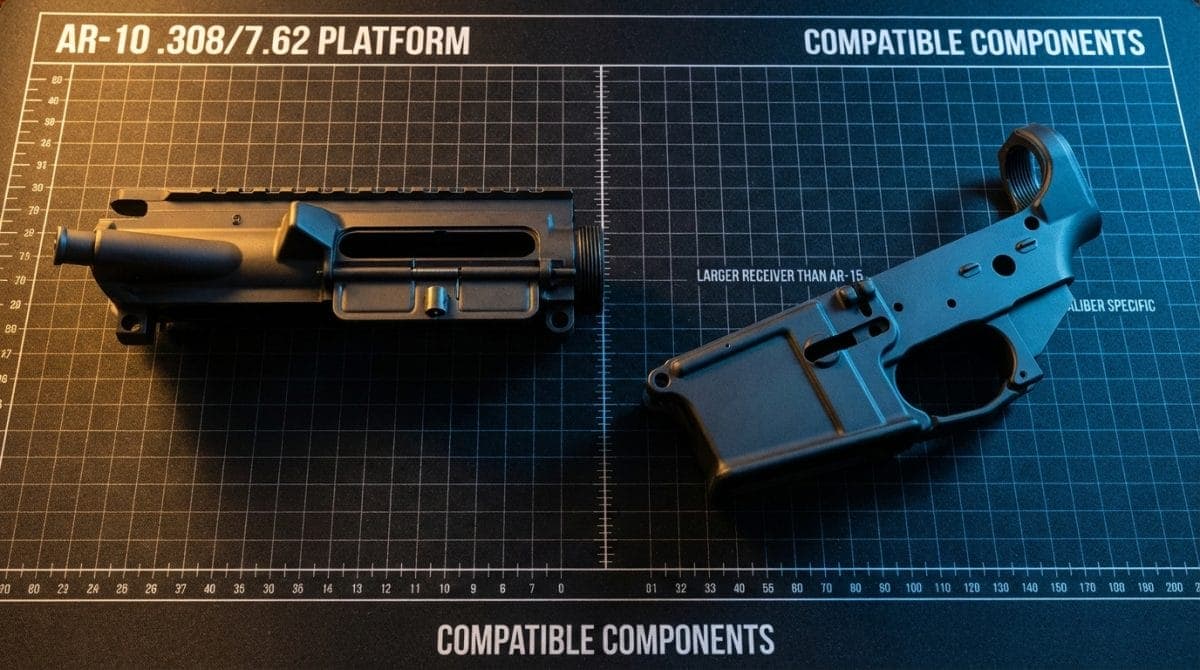
The size difference between these platforms becomes immediately apparent when comparing receivers. An AR-15 upper receiver typically measures 7.5 inches in length, while an AR-10 upper stretches to approximately 8.5 inches. This extra inch accommodates the longer .308 cartridge.
Lower receiver dimensions show similar disparities:
- AR-15 magazine well: 2.25 inches deep x 0.88 inches wide
- AR-10 magazine well: 2.65 inches deep x 0.95 inches wide
Weight differences are substantial. A complete ar-15 typically weighs between 6.5 and 8 pounds depending on configuration. A comparably equipped ar-10 generally weighs between 9 and 11 pounds. This 2.5 to 3-pound difference becomes noticeable during extended carrying or shooting sessions.
Parts Compatibility: What Cannot Be Shared
Understanding parts compatibility prevents costly mistakes when building. The following components are NOT interchangeable between platforms:
- Upper and lower receivers: Different dimensions make cross-platform assembly impossible
- Barrels: Chamber dimensions and gas port locations differ completely
- Bolt carrier groups: AR-10 BCGs are longer (typically 8.5 inches vs 6.75 inches) and heavier
- Charging handles: AR-10 handles are wider to match receiver dimensions
- Magazines: Completely different sizes and feed lip geometries
- Buffer systems: AR-10 requires heavier buffers (typically 5.4 oz vs 3.0 oz for standard AR-15)
- Handguards: Different barrel nut threads and mounting dimensions
However, some parts typically work across both platforms:
- Most pistol grips (standard AR pattern)
- Many trigger groups (though some high-end triggers are platform-specific)
- Most stocks (if using the same buffer tube diameter)
- Safety selectors
- Magazine releases (in most cases)
DPMS vs Armalite Pattern: The AR-10 Complexity
Unlike the standardized AR-15, the AR-10 exists in two incompatible patterns. This represents a major consideration when selecting parts for your build.
The DPMS pattern (also called LR-308) has become the more common standard, used by manufacturers including Aero Precision, Palmetto State Armory, and others. The Armalite pattern remains proprietary to Armalite and a few licensed manufacturers.
Key differences include:
- Barrel extensions: Different thread pitches and dimensions
- Bolt carriers: Slightly different rail heights and dimensions
- Upper/lower fitment: Rear takedown pin locations vary by 0.050 inches
- Magazines: DPMS uses modified SR-25 pattern; Armalite uses proprietary design
When building an ar-10, you must commit to one pattern and ensure all major components match. Mixing patterns typically results in non-functional rifles.
Effective Range Comparison
The practical effective range represents another significant ar-15 vs ar-10 difference. With standard 55-grain ammunition, an AR-15 maintains supersonic velocity to approximately 500 yards from a 16-inch barrel. The 5.56 NATO round typically drops 53.7 inches at 500 yards with a 100-yard zero.
The AR-10 firing 147-grain 7.62 NATO maintains supersonic velocity beyond 900 yards from a 20-inch barrel. At 500 yards, the same load drops approximately 49.5 inches with a 100-yard zero, demonstrating superior long-range ballistics.
For practical accuracy on human-sized targets:
- AR-15: Effective to 600 yards with proper optics and ammunition
- AR-10: Effective to 800+ yards with comparable equipment
Recoil and Shootability Analysis
Recoil represents a major factor in platform selection. Using standard loads and rifle weights:
An 8-pound ar15 firing 55-grain 5.56 NATO generates approximately 4.5 foot-pounds of free recoil energy. The same weight ar-10 firing 147-grain 7.62 NATO produces approximately 15.8 foot-pounds: over three times the recoil energy.
This increased recoil affects:
- Follow-up shot speed: AR-15 allows faster target reacquisition
- Shooter fatigue: AR-10 causes more fatigue during extended sessions
- Training costs: Higher recoil may require more practice to maintain proficiency
Ammunition Cost Considerations
Current market prices show significant cost differences between platforms. As of 2024, bulk 5.56 NATO ammunition typically costs $0.40 to $0.60 per round for brass-cased options. Comparable .308/7.62 NATO ammunition runs $0.70 to $1.20 per round.
For a typical range session of 200 rounds:
- AR-15: $80 to $120 in ammunition
- AR-10: $140 to $240 in ammunition
This 75% to 100% premium for ar-10 ammunition significantly impacts long-term training costs.
Platform Comparison Table
| Specification | AR-15 | AR-10 |
|---|---|---|
| Primary Calibers | .223 Rem / 5.56 NATO | .308 Win / 7.62 NATO |
| Typical Weight | 6.5 – 8 lbs | 9 – 11 lbs |
| Muzzle Energy | ~1,282 ft-lbs | ~2,470 ft-lbs |
| Effective Range | 600 yards | 800+ yards |
| Recoil Energy | ~4.5 ft-lbs | ~15.8 ft-lbs |
| Magazine Capacity | 30 rounds standard | 20 rounds standard |
| Ammo Cost/Round | $0.40 – $0.60 | $0.70 – $1.20 |
| Platform Standardization | Highly standardized | Two major patterns |
Use Case Analysis
Selecting between platforms depends heavily on intended use. The AR-15 excels for:
- Home defense: Lower penetration risk with appropriate ammunition
- Competition shooting: Faster follow-up shots in 3-gun and similar sports
- Varmint hunting: Adequate power for coyotes, prairie dogs, and similar game
- General range use: Lower ammunition costs enable more practice
- New shooters: Manageable recoil promotes skill development
The AR-10 becomes the better choice for:
- Long-range precision: Superior ballistics beyond 600 yards
- Large game hunting: Adequate power for deer, elk, and similar animals
- Designated marksman roles: Extended effective range with barrier penetration
- Areas with longer shooting distances: Western states with open terrain
Building Considerations
When planning your build, consider these factors:
For AR-15 builds, the widespread standardization means nearly universal parts compatibility. You can mix components from different manufacturers with confidence. Barrel options range from 7.5-inch pistols to 24-inch varmint configurations, with 16-inch carbines representing the most popular choice.
For AR-10 builds, first determine your pattern (DPMS or Armalite), then source all major components accordingly. Barrel selection typically starts at 16 inches, with 18 and 20-inch options providing better velocity for long-range work. Buffer system selection becomes more important: standard carbine buffers often prove too light, leading to excessive bolt velocity and premature wear.
Recommended Parts
Whether you choose to build an ar-15 or ar-10, selecting quality parts ensures reliable performance. For AR-15 builders, start with the AR15 Outfitters Builder to configure your rifle and compare prices across multiple retailers.
For a balanced AR-15 build, consider:
- Lower receivers from established manufacturers with proper QC standards
- Upper receivers with M4 feed ramps for reliability
- Barrels in 16-inch mid-length gas configuration for optimal dwell time
- BCGs with properly staked gas keys and MPI/HPT testing
- Handguards using modern mounting systems for stability
- Triggers in the 4.5 to 5.5-pound range for general use
- Muzzle devices that match your intended use
- Adjustable gas blocks for tuning with suppressors
- Buffer tubes in mil-spec dimensions for compatibility
- Stocks appropriate for your length of pull
- Grips that fit your hand size
The AR15 Outfitters Builder allows you to select each component category, ensuring compatibility while comparing real-time pricing from multiple vendors. This tool proves especially valuable for first-time builders navigating the extensive parts ecosystem.
Remember that the ar-15 vs ar-10 difference extends beyond just size and caliber. Each platform serves specific roles, and understanding these differences ensures you invest in the right tool for your needs. The AR-15 provides an affordable, versatile platform suitable for most shooters, while the AR-10 delivers extended range and power for specialized applications.
Disclaimer: AR15 Outfitters does not sell firearms. This site is an information and affiliate resource only. All purchases are completed through licensed retailers. Always comply with all federal, state, and local laws when building or purchasing firearms and firearm components.