
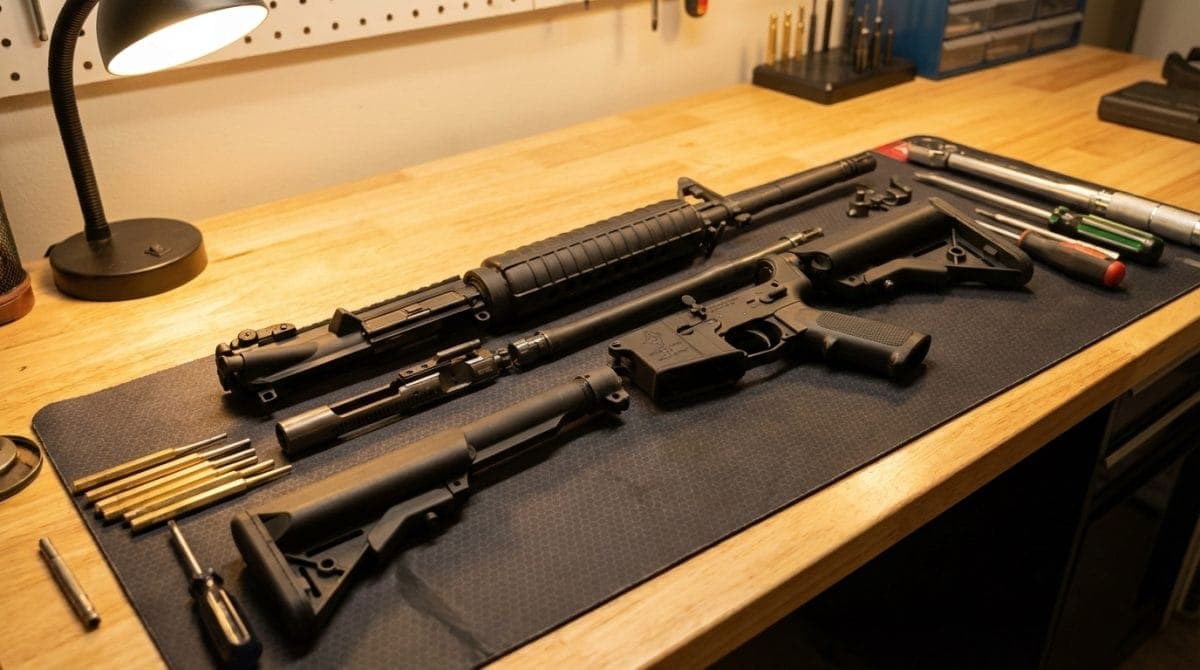
How to Adjust an AR-15 Gas Block
By AR-15 Outfitters · April 10, 2026
AR15 Outfitters may earn a commission on purchases made through links in this guide. This does not affect pricing or our recommendations.
Getting your AR-15 to run exactly how you want it starts with understanding and adjusting your gas system. An adjustable gas block gives you precise control over how much gas drives your bolt carrier group, letting you tune everything from recoil impulse to ejection pattern. Whether you’re switching between suppressed and unsuppressed shooting, running different buffer weights, or just want the smoothest possible cycling, learning to properly adjust your gas block transforms a good rifle into a great one.
Why Tune Your AR-15 Gas System?
Most factory AR-15s come over-gassed to ensure reliable function with the widest variety of ammo. While this works, it creates several issues:
- Excessive recoil: More gas pressure means harder bolt carrier acceleration
- Violent brass ejection: Over-gassed rifles typically eject brass at 1-2 o’clock instead of the ideal 3-4 o’clock
- Increased wear: Components take unnecessary beating from excessive bolt velocity
- Poor suppressor performance: Adding a suppressor to an already over-gassed rifle compounds these problems
An adjustable gas block lets you dial in the exact amount of gas needed for reliable function, typically reducing felt recoil by 20-30% while extending component life.
Understanding AR Gas System Components
Before adjusting anything, you need to understand how gas flows through your AR:
- Gas exits the barrel through the gas port
- Enters the gas block and travels down the gas tube
- Pushes against the gas key on your bolt carrier group
- Drives the BCG rearward against the buffer and buffer spring
- Extracts and ejects the spent case while compressing the buffer spring
- Returns forward, stripping a new round from the magazine
An adjustable gas block adds a valve or restriction screw at step 2, controlling how much gas enters the gas tube.
Complete Parts List
Here’s everything you need to properly tune your gas system:
Adjustable Gas Block Options
- Superlative Arms .750″ Clamp-On – Bleed-off design, 30 position adjustment
- SLR Rifleworks Sentry 7 – 15 position click adjustment
- Wojtek Weaponry .750″ Set Screw – Budget option with infinite adjustment
Buffer System Components
- Sprinco White Buffer Spring – Standard weight for initial tuning
- H2 Buffer (4.6-4.7 oz) – Good starting weight for 16″ barrels
- H Buffer (3.8 oz) – Alternative for lighter setups
Tools Required
- 3/32″ Allen key (for most adjustment screws)
- Torque wrench capable of 30-35 in-lbs
- Upper receiver vise block
- Aeroshell 33MS or similar grease
- Blue Loctite 242 (medium strength)
- Punch set for gas tube roll pin
Step-by-Step Installation and Adjustment
Installing the Adjustable Gas Block
Step 1: Remove existing gas block
Drive out the gas tube roll pin using a 5/64″ punch. Remove set screws or taper pins securing the old gas block. Slide it forward off the barrel.
Step 2: Clean the barrel journal
Remove any carbon buildup where the gas block sits. The journal should be clean metal for proper fitment.
Step 3: Install new adjustable gas block
Apply a thin layer of Aeroshell 33MS to the barrel journal. Slide the gas block on, aligning the gas port with the barrel’s gas port. For set screw models, torque screws to 30-35 in-lbs with blue Loctite. For clamp-on models, torque to manufacturer specification (typically 25-30 in-lbs).
Step 4: Reinstall gas tube
Insert gas tube into the upper receiver first, then into the gas block. Drive in the roll pin, ensuring it’s centered and flush on both sides.
Initial Gas Adjustment Process
Step 1: Start with gas fully open
Turn the adjustment screw counterclockwise until it stops. This is maximum gas flow.
Step 2: Load one round in magazine
Use your standard ammo. Federal XM193 (55gr) or XM855 (62gr) work well for baseline tuning.
Step 3: Fire and observe
The bolt should lock back on the empty magazine. Note the ejection pattern: it’s probably throwing brass forward at 1-2 o’clock.
Step 4: Gradually restrict gas
Turn the adjustment screw clockwise 1/2 turn. Fire another single round. Repeat this process, watching for:
- Ejection pattern moving from 1-2 o’clock toward 3-4 o’clock
- Brass landing closer rather than being launched 20 feet
- Bolt still locking back reliably
Step 5: Find the failure point
Continue restricting gas until the bolt fails to lock back. Note this position.
Step 6: Add safety margin
Open the gas block 1.5-2 full turns from the failure point. This provides reliable function with some margin for fouling or weak ammo.
Fine-Tuning for Specific Configurations
Suppressor Use
When adding a suppressor, you’ll typically need to close the gas block an additional 2-3 turns from your unsuppressed setting. The suppressor increases backpressure significantly. Start with your unsuppressed setting and repeat the tuning process with the can attached.
Different Buffer Weights
Heavier buffers (H2, H3) require more gas to function reliably. If switching from an H1 to H2 buffer, you’ll generally need to open the gas block 1/2 to 1 full turn. Lighter buffers allow more gas restriction.
Barrel Length Considerations
| Barrel Length | Typical Starting Point | Common Buffer Weight |
|---|---|---|
| 10.5-11.5″ | 4-5 turns from closed | H or Standard |
| 14.5-16″ | 3-4 turns from closed | H2 |
| 18-20″ | 2-3 turns from closed | H2 or H3 |
Common Mistakes to Avoid
Over-restricting gas: Running at the absolute minimum gas setting leaves no margin for reliability. Always maintain that 1.5-2 turn safety buffer.
Not checking with different ammo: Tune with your weakest ammo, not your hottest. Steel case typically needs more gas than brass.
Ignoring ejection pattern: Brass ejection tells you everything. 3-4 o’clock is ideal. 5-6 o’clock means under-gassed, 1-2 o’clock means over-gassed.
Forgetting to re-tune after changes: Any change to buffer weight, spring rate, BCG, or adding a suppressor requires re-tuning.
Using wrong thread locker: Red Loctite on adjustment screws will permanently lock them. Use blue (medium strength) only.
Verifying Proper Function
After initial tuning, verify your settings with these tests:
- 10-round rapid fire: All cases should eject consistently at 3-4 o’clock
- Single round from closed bolt: Should lock back reliably
- Different magazines: Test with aluminum GI, Magpul, and Lancer mags
- Different positions: Shoot from bench, standing, and weak side
- Temperature test: If possible, verify function in cold weather
Build This on AR15 Outfitters
Ready to build an optimally tuned AR-15? Head over to the AR15 Outfitters Builder to configure your perfect gas system setup. The builder lets you:
- Compare prices across multiple retailers for each component
- Ensure compatibility between your chosen gas block, barrel, and handguard
- Save and share your build configuration
- Track price history to buy at the best time
Start with selecting your barrel length and gas system length, then choose from our curated selection of adjustable gas blocks. The builder automatically filters to show only compatible components, eliminating guesswork. Add your preferred buffer system components, and you’ll have a properly matched, tunable gas system ready to order.
Remember: a properly tuned AR-15 isn’t just about reducing recoil. It’s about creating a rifle that runs exactly how you want it, extends component life, and delivers consistent performance whether you’re running suppressed, unsuppressed, or switching between different loads. Take the time to dial in your adjustable gas block properly, and you’ll immediately feel the difference in how your rifle shoots.
Disclaimer: AR15 Outfitters does not sell firearms. This site is an information and affiliate resource only. All purchases are completed through licensed retailers. Always comply with all federal, state, and local laws when building or purchasing firearms and firearm components.