
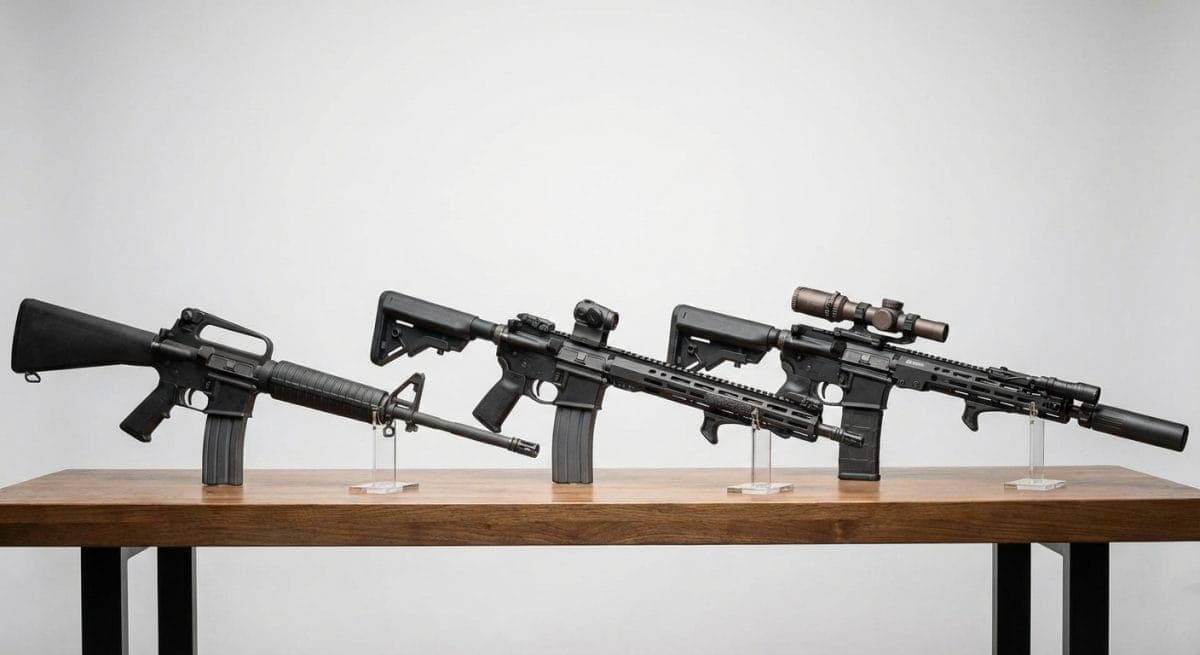
How to Choose Your First AR-15 Build
By AR-15 Outfitters · April 9, 2026
AR15 Outfitters may earn a commission on purchases made through links in this guide. This does not affect pricing or our recommendations.
Building your first AR-15 represents a significant milestone in firearm ownership. Rather than purchasing a pre-built rifle, assembling your own AR-15 gives you complete control over component selection, budget allocation, and performance characteristics. This guide walks through every decision point for first-time builders, providing specific recommendations backed by real-world testing data.
Understanding AR-15 Components for Beginners
An AR-15 consists of two main assemblies: the upper receiver and the lower receiver. These assemblies contain approximately 100 individual parts total, though many builders purchase pre-assembled components to simplify their first build.
The lower receiver serves as the firearm’s foundation and is legally considered the actual “firearm” by the ATF. This serialized component must be purchased through an FFL dealer. Everything else can be ordered directly to your home in most states.
Essential Component Categories
Your AR-15 build requires components from eight primary categories:
- Lower Receiver: The serialized frame (typically $50-150)
- Lower Parts Kit (LPK): Springs, detents, and controls (typically $40-80)
- Buffer System: Buffer tube, spring, and weight (typically $50-100)
- Stock: Fixed or adjustable buttstock (typically $30-200)
- Upper Receiver: Complete or stripped (typically $70-500)
- Barrel: Length and profile selection (typically $100-400)
- Bolt Carrier Group (BCG): The heart of the action (typically $80-250)
- Handguard: Free-float or drop-in style (typically $50-300)
Complete Parts List for Your First AR-15 Build
This parts list represents a balanced approach for beginners, prioritizing reliability and value. Visit AR15 Outfitters Builder to configure these components:
Lower Receiver Assembly
| Component | Specification | Typical Price Range |
|---|---|---|
| Lower Receiver | Forged 7075-T6 aluminum | $60-100 |
| Lower Parts Kit | Mil-spec with grip | $45-60 |
| Trigger (if not in LPK) | Mil-spec or enhanced single-stage | $30-150 |
| Buffer Tube | Mil-spec diameter (1.14″) | $20-35 |
| Buffer Spring | Carbine length | $10-20 |
| Buffer Weight | Carbine (3.0 oz) | $20-30 |
| Stock | Adjustable carbine stock | $35-80 |
Upper Receiver Assembly
| Component | Specification | Typical Price Range |
|---|---|---|
| Upper Receiver | Forged with forward assist and dust cover | $70-120 |
| Barrel | 16″ carbine gas, 1:7 or 1:8 twist | $120-200 |
| Gas Block | 0.750″ low-profile | $15-30 |
| Gas Tube | Carbine length stainless | $12-20 |
| Handguard | 12-15″ free-float M-LOK | $80-150 |
| Bolt Carrier Group | Mil-spec phosphate or nitride | $90-130 |
| Charging Handle | Standard mil-spec | $20-40 |
| Muzzle Device | A2 flash hider | $8-15 |
Required Tools and Equipment
Proper tools prevent damage and ensure correct assembly. While specialized AR-15 tools exist for every task, beginners can complete their first build with these essentials:
Critical Tools
- Armorer’s Wrench: For castle nut and muzzle device installation ($25-40)
- Punch Set: Roll pin punches in 1/16″, 3/32″, 1/8″, and 5/32″ ($15-25)
- Hammer: Brass or nylon face to prevent marring ($15-20)
- Torque Wrench: 1/2″ drive capable of 30-80 ft-lbs ($40-80)
- Vise: Bench-mounted with soft jaws ($50-100)
- Upper Receiver Vise Block: Prevents crushing while torquing ($20-40)
Helpful Additions
- Needle-nose pliers for spring installation
- Electrical tape for protecting finish
- Gun oil or grease for lubrication
- Blue Loctite for semi-permanent fasteners
- Magnet for retrieving dropped detents
Step-by-Step Assembly Instructions
Assembly divides into two phases: lower receiver assembly followed by upper receiver assembly. Most beginners complete their first build in 2-4 hours.
Lower Receiver Assembly
Step 1: Install the Magazine Release
Insert the magazine release button from the left side of the receiver. Thread the magazine release spring onto the threaded portion from the right side. Depress the button fully, then thread the magazine catch onto the exposed threads. Rotate the catch 8-10 full turns while keeping the button depressed.
Step 2: Install the Trigger Guard
Insert the forward portion of the trigger guard into the front pin hole. Use a 1/8″ roll pin punch to drive the rear roll pin through the rear lug. Support the receiver ears with a block to prevent cracking. The pin should sit flush on both sides.
Step 3: Install the Bolt Catch
Position the bolt catch spring and plunger in the receiver pocket. Hold in place while aligning the bolt catch from the opposite side. Drive the roll pin through using a 3/32″ punch. This typically requires firm strikes due to the tight fit.
Step 4: Install the Pivot Pin
Insert the detent spring into the forward takedown pin hole, followed by the detent pin (pointed end up). Compress the detent while sliding the pivot pin through both receiver lugs. The detent should snap into the groove on the pin.
Step 5: Install Fire Control Group
Drop the trigger into the receiver with the springs facing forward. Insert the trigger pin from left to right. Install the hammer with springs positioned over the trigger pin. Drive the hammer pin through from left to right. Verify smooth operation before proceeding.
Step 6: Install the Pistol Grip
Insert the safety selector detent (pointed end up) and spring into the grip mounting hole. Install the safety selector to the “safe” position. Thread the grip screw through the washer and into the lower receiver while compressing the safety spring. Tighten to 35-40 inch-pounds.
Step 7: Install Buffer Tube Assembly
Insert the buffer retainer spring and pin into the threaded hole at the rear of the receiver. Thread the buffer tube clockwise until it captures the buffer retainer. Back off slightly if needed for proper castle nut alignment. Install the end plate and castle nut. Torque castle nut to 40 ft-lbs. Stake in at least two places.
Step 8: Complete the Stock
Insert the buffer spring into the tube, followed by the buffer. For adjustable stocks, depress the adjustment lever and slide onto the buffer tube. Fixed stocks typically require removing the screw and spacer first.
Upper Receiver Assembly
Step 1: Install the Barrel
Apply a thin coat of grease to the barrel extension. Insert the barrel into the upper receiver, aligning the indexing pin with the notch. Install the barrel nut hand-tight, then torque to 30 ft-lbs minimum. If gas tube holes don’t align, continue tightening up to 80 ft-lbs maximum until they do.
Step 2: Install Gas System
Slide the gas block onto the barrel journal (0.750″ typically for carbine barrels). Align gas ports using a 0.125″ drill bit or alignment tool. For set-screw blocks, apply Loctite and tighten to 25-30 inch-pounds. Insert the gas tube through the gas block and into the receiver. Secure with the gas tube roll pin.
Step 3: Install Handguard
Free-float handguards mount directly to the barrel nut via proprietary mounting systems. Follow manufacturer instructions, but typically involves timing the barrel nut for proper accessory alignment, then securing the handguard with provided hardware. Torque values vary by design but generally range from 25-40 ft-lbs.
Step 4: Install Muzzle Device
Thread the crush washer onto the barrel with the cupped side facing the muzzle device. Hand-tighten the muzzle device, then use an armorer’s wrench to align timing. A2 flash hiders position with the closed end at 12 o’clock. Torque to 15-20 ft-lbs or hand-tight plus 90 degrees with crush washer.
Step 5: Install BCG and Charging Handle
Pull the charging handle partially back. Insert the bolt carrier group with bolt forward and ejection port cover open. Push both fully forward until the charging handle latches.
Common Mistakes to Avoid
First-time builders frequently encounter these issues:
Safety Selector Problems
Installing the pistol grip without the safety detent and spring results in a non-functional safety. Always verify the detent spring tension before final tightening. The selector should click positively between positions.
Gas Block Alignment
Misaligned gas ports cause short-stroking or complete failure to cycle. Always verify alignment with proper tools. A 0.125″ drill bit inserted through both ports confirms proper positioning.
Over-Torquing Castle Nut
Exceeding 80 ft-lbs can damage buffer tube threads. Use a torque wrench and stop at 40 ft-lbs for standard installations. Staking provides security without excessive torque.
Backwards Springs
Hammer and trigger springs install in specific orientations. The legs should rest on top of the trigger pin. Incorrect installation prevents proper reset and can cause light strikes.
Missing Gas Tube Roll Pin
Forgetting this tiny pin allows the gas tube to walk out during firing. The pin installs through the gas block perpendicular to the tube. Use a 5/64″ punch for standard blocks.
Testing and Function Checks
Before live fire, perform these function checks:
- Safety Check: With hammer cocked and safety on, pull trigger firmly. Hammer should not fall.
- Trigger Reset: With safety off, pull trigger to drop hammer. Hold trigger back while manually cocking hammer. Release trigger slowly to feel/hear reset.
- Bolt Carrier Function: Manually cycle the action. The bolt should lock into battery smoothly.
- Magazine Fit: Insert empty magazine. It should lock positively and drop free when released.
Build This on AR15 Outfitters
Ready to choose components for your first AR-15 build? The AR15 Outfitters Builder provides real-time compatibility checking and price comparisons across multiple retailers. Start with our beginner-friendly templates or build from scratch.
The builder tool automatically verifies:
- Gas system length matching between barrel and gas tube
- Handguard clearance for your selected gas block
- Buffer system compatibility with barrel length
- Thread pitch matching for muzzle devices
For your first build, consider starting with our “Basic Carbine” template, which includes proven components selected for reliability and value. From there, customize individual parts based on your budget and intended use. The platform updates pricing daily from major retailers, ensuring you get the best deal on every component.
Building an AR-15 teaches valuable skills while creating a rifle tailored to your exact preferences. With proper tools and attention to detail, first-time builders regularly produce rifles that rival or exceed factory offerings. Take your time, double-check each step, and enjoy the process of creating your first AR-15.
Disclaimer: AR15 Outfitters does not sell firearms. This site is an information and affiliate resource only. All purchases are completed through licensed retailers. Always comply with all federal, state, and local laws when building or purchasing firearms and firearm components.