
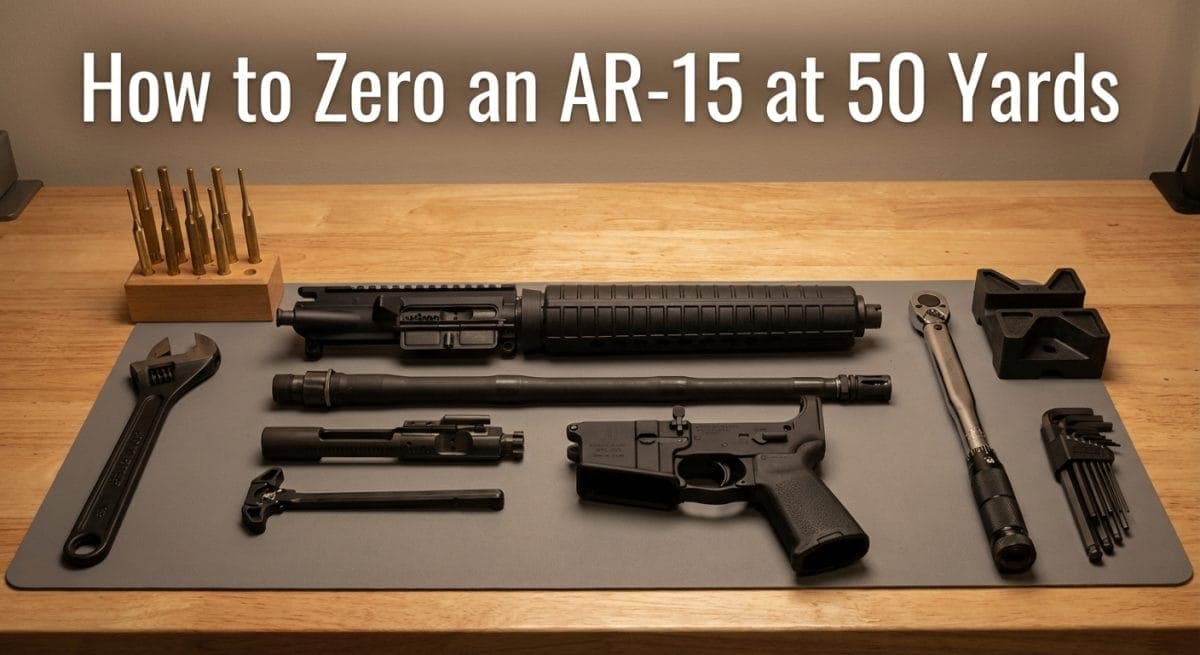
How to Zero an AR-15 at 50 Yards
By AR-15 Outfitters · April 10, 2026
AR15 Outfitters may earn a commission on purchases made through links in this guide. This does not affect pricing or our recommendations.
Getting your AR-15 zeroed at 50 yards provides one of the most versatile sight-in distances for the platform. A properly executed 50-yard zero gives you practical accuracy from point-blank range out to 200 yards with minimal holdover adjustments. This guide walks you through the complete process, from gathering the right equipment to making those final adjustments that lock in your zero.
Why a 50-Yard Zero Makes Sense
The 50-yard zero has become increasingly popular among AR-15 shooters for good reason. With standard 55-grain or 62-grain 5.56 NATO ammunition, a rifle zeroed at 50 yards will typically impact within 2 inches of your point of aim from 25 yards out to 200 yards. At 100 yards, you’re looking at approximately 1.2 inches high, and at 200 yards, you’ll be roughly 1.8 inches low. This minimal deviation means you can engage targets effectively without memorizing complex holdover charts.
The ballistic trajectory of a 50-yard zero closely mirrors that of a 200-yard zero, but requires significantly less range space and makes the zeroing process easier for most shooters. You’ll use less ammunition, see your impacts more clearly, and achieve a stable zero faster than attempting a true 200-yard zero.
Essential Equipment for Your Zero
Before heading to the range, ensure you have these components properly installed on your AR-15:
- Optic or Iron Sights: Whether using a red dot, scope with magnification, or iron sights, ensure they’re mounted with proper torque specs (typically 15-20 inch-pounds for scope rings, 65 inch-pounds for most optic mounts)
- Quality Ammunition: Bring at least 40 rounds of the same ammunition you plan to use regularly. Match-grade isn’t necessary, but consistency matters
- Stable Shooting Rest: A bipod, sandbags, or shooting bags to eliminate human error
- Adjustment Tools: Appropriate tools for your sight adjustments (typically a flathead screwdriver for iron sights, or a coin for most optic turrets)
- Targets: High-contrast targets with 1-inch grid squares work best for precise adjustments
Preparing Your Rifle and Optic
Start with a properly assembled AR-15. If you’re mounting a new optic, torque the mount to manufacturer specifications: typically 65 inch-pounds for a standard Picatinny mount. For scope rings, apply 15-20 inch-pounds unless otherwise specified. These torque values prevent movement under recoil while avoiding damage to your optic.
Perform a rough mechanical zero before heading to the range. For scopes, this means centering the reticle in its adjustment range. Count the total clicks from stop to stop in both windage and elevation, then return to the center point. For red dots, start with the adjustments centered if possible.
The Step-by-Step Zeroing Process
Initial Shots at 25 Yards
Begin your zero at 25 yards to get on paper quickly. This saves ammunition and frustration. Set up a stable shooting position using your rest or bipod. Fire a careful 3-shot group, aiming at the exact same point for each shot. Don’t worry about where the rounds impact initially; focus on shooting a tight group.
Measure the distance from your group center to your point of aim. At 25 yards, most AR-15 sights and optics adjust 1 click per 0.25 inches of impact change. If your group is 2 inches right and 3 inches low, you’ll need 8 clicks left and 12 clicks up.
Moving to 50 Yards
Once you’re hitting within 2 inches of point of aim at 25 yards, move your target to 50 yards. The adjustment values change at this distance: typically 1 click equals 0.5 inches at 50 yards for most optics (this translates to 1 MOA or 0.25 MIL adjustments).
Fire a 5-shot group from a stable position. Calculate the center of your group and measure its offset from your point of aim. Make adjustments based on these measurements. If you’re 1.5 inches right and 2 inches high, you’ll need 3 clicks left and 4 clicks down.
Fine-Tuning Your Zero
After your initial adjustments at 50 yards, fire another 5-shot group. Your point of impact should now be much closer to your point of aim. Make any final adjustments needed, but remember that a “perfect” zero is rarely achievable. If you’re within 0.5 inches of your point of aim at 50 yards, you have an excellent zero.
Confirm your zero with a final 5-shot group. This group should cluster around your point of aim. Document your zero: note the ammunition used, weather conditions, and date. This information proves valuable for future reference.
Verifying at Different Distances
With your 50-yard zero established, verify your point of impact at other distances:
- At 25 yards: Expect impacts approximately 0.5 inches low
- At 100 yards: Impacts typically hit 1.2 inches high
- At 200 yards: Impacts generally fall 1.8 inches low
These values vary slightly based on your specific ammunition, barrel length, and environmental conditions, but provide reliable starting points for holdover estimates.
Common Zeroing Mistakes to Avoid
Several errors can derail your zeroing process:
- Loose Optic Mounts: Always verify proper torque before zeroing. A mount that shifts under recoil wastes ammunition and time
- Inconsistent Ammunition: Switching between different loads during zeroing introduces unnecessary variables
- Poor Shooting Fundamentals: Rushing shots or using improper technique masks your rifle’s true accuracy
- Chasing Single Shots: Always fire groups and adjust based on the group center, not individual impacts
- Environmental Ignorance: Strong winds or extreme temperatures affect your zero. Note conditions and rezero if they change significantly
Maintaining Your Zero
Once achieved, protect your zero through proper maintenance. Check optic mount screws periodically, especially after the first 100 rounds. Apply a drop of blue thread locker if screws tend to loosen. Store your rifle properly to prevent impacts that might shift your optic.
Verify your zero periodically, especially before important range sessions or if your rifle experiences any impacts. A quick 3-shot group at 50 yards confirms your sight alignment remains true.
Build This Setup on AR15 Outfitters
Ready to build an AR-15 optimized for accurate shooting? Visit AR15 Outfitters’ configurator to spec out your precision rifle build. Start with a quality upper receiver and free-float handguard for consistent accuracy. Add a match-grade barrel in 16″ or 18″ length for optimal velocity with common ammunition. Select a reliable optic mount and quality trigger to maximize your rifle’s accuracy potential. The builder tool ensures compatibility between components while comparing prices across multiple vendors, helping you create an accurate rifle within your budget.
Disclaimer: AR15 Outfitters does not sell firearms. This site is an information and affiliate resource only. All purchases are completed through licensed retailers. Always comply with all federal, state, and local laws when building or purchasing firearms and firearm components.