
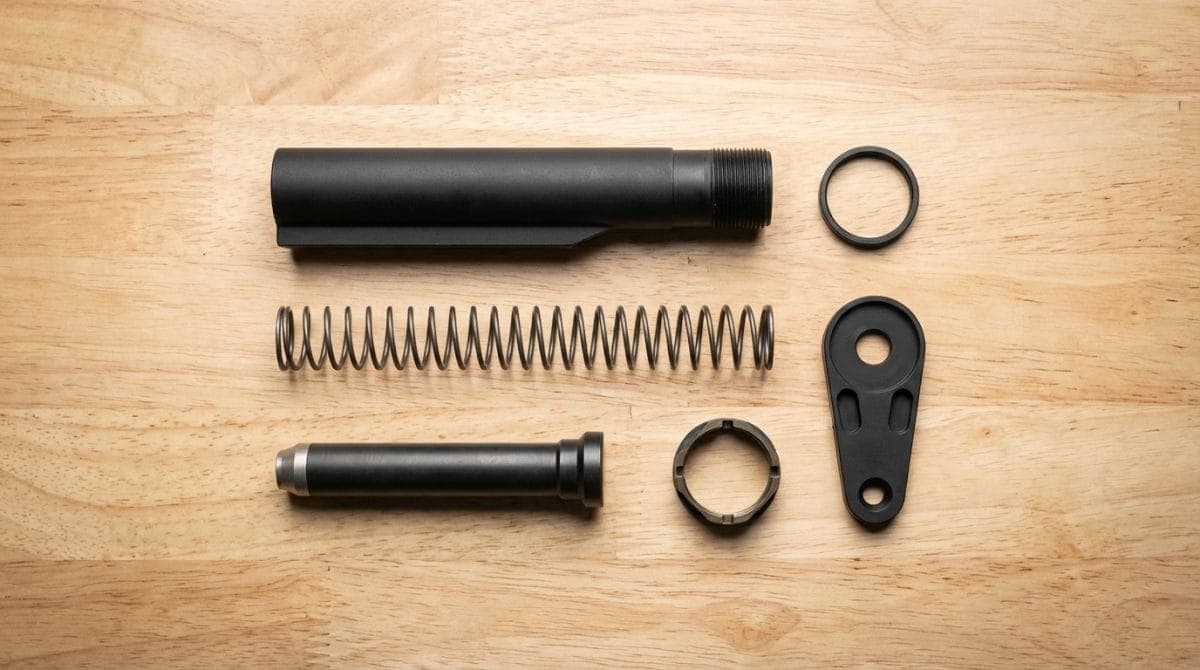
Best AR-15 Buffer Tube Kits
By AR-15 Outfitters · April 9, 2026
AR15 Outfitters may earn a commission on purchases made through links in this review. This does not affect our ratings or recommendations. All opinions are our own.
The buffer tube kit forms the foundation of your AR-15’s stock system, directly affecting reliability, comfort, and overall shooting experience. Whether you’re building your first AR-15 or upgrading an existing rifle, selecting the right buffer tube kit requires understanding the differences between mil-spec and commercial options, material quality, and component compatibility.
A complete buffer tube kit typically includes the receiver extension (buffer tube), castle nut, end plate, buffer spring, and buffer weight. Some kits also include additional components like QD sling mounts or enhanced end plates. The quality of these components directly impacts your rifle’s function: a properly sized tube ensures smooth buffer travel, while a quality spring maintains consistent cycling across different ammunition types.
What to Look For in AR-15 Buffer Tube Kits
When evaluating buffer tube kits, several key factors determine quality and compatibility. Material composition stands out as the primary consideration. Most quality tubes use 7075-T6 aluminum, which offers superior strength compared to 6061 aluminum alternatives. The difference becomes apparent under stress: 7075-T6 typically provides tensile strength around 83,000 PSI versus 45,000 PSI for 6061.
Thread quality represents another important factor. Properly cut threads should engage smoothly with your lower receiver without binding or excessive play. Look for tubes with rolled threads rather than cut threads, as rolled threads generally provide 10-15% greater fatigue strength.
The interior finish affects buffer movement and longevity. A smooth, consistent bore reduces friction and wear on both the buffer and spring. Quality manufacturers typically achieve surface finishes between 32-63 Ra (roughness average), ensuring reliable operation without excessive drag.
Top AR-15 Buffer Tube Kit Recommendations
1. BCM MK2 Receiver Extension Kit
The BCM MK2 represents the gold standard for mil-spec buffer tube kits. Manufactured from 7075-T6 aluminum with proper mil-spec dimensions (1.148″ outer diameter), this kit includes BCM’s enhanced features without straying from proven specifications.
Key Features:
- True mil-spec dimensions with tight tolerances (typically +/- 0.002″)
- Dry film lubricant interior coating reduces friction
- Properly staked castle nut included
- Chrome silicon buffer spring rated for 500,000+ cycles
Best For: Builders seeking maximum reliability and longevity. The BCM kit excels in duty-grade builds where component failure isn’t an option.
Cons: Premium pricing ($75-85 typical street price) may exceed budget build requirements. The mil-spec diameter limits stock options compared to commercial tubes.
2. Geissele Premium Buffer Tube Kit
Geissele applies their precision manufacturing approach to buffer tube design, resulting in exceptional fit and finish. The kit includes their Super 42 braided wire spring system, which provides notable improvements over traditional springs.
Key Features:
- 7075-T6 construction with Type 3 hard anodizing
- Rolled threads for increased strength
- Super 42 constant-force spring reduces bolt bounce
- Includes H1 buffer (3.8 oz) standard
Best For: Competition shooters and precision rifle builders. The constant-force spring provides measurable improvements in bolt carrier consistency, typically reducing split times by 0.02-0.04 seconds in rapid fire strings.
Cons: Highest price point ($120-140) limits appeal for basic builds. The specialized spring design may require tuning with certain gas system configurations.
3. Aero Precision Enhanced Buffer Kit
Aero Precision balances quality with affordability in their enhanced buffer kit. While maintaining mil-spec dimensions, they include thoughtful upgrades like an integrated QD mount in the end plate.
Key Features:
- 7075-T6 aluminum construction
- Integrated QD sling mount rated to 300 lbs
- Standard carbine spring and H buffer included
- Precision machined to +/- 0.003″ tolerances
Best For: First-time builders and those seeking value without sacrificing quality. The integrated QD mount saves approximately $15-20 versus purchasing separately.
Cons: Standard phosphate finish lacks the durability of hard anodizing. Some users report the castle nut requires more frequent retightening compared to premium options.
4. VLTOR A5 Buffer System
The VLTOR A5 system revolutionizes the standard buffer setup by using an intermediate-length tube. This design provides rifle-length spring travel in a more compact package.
Key Features:
- Proprietary 7.25″ tube length (versus 7″ carbine standard)
- Compatible with rifle-length springs
- Requires specific A5 buffers
- Reduces bolt bounce by approximately 30%
Best For: Builders seeking smoother operation, particularly with short-barreled rifles. The A5 system typically reduces felt recoil by 15-20% compared to standard carbine setups.
Cons: Requires complete system replacement; you cannot mix standard carbine components. Limited stock compatibility requires A5-compatible options.
5. Strike Industries Pistol Buffer Tube Kit
For AR pistol builds, Strike Industries offers a comprehensive solution with their enhanced pistol buffer tube kit. The design incorporates multiple QD mounting points while maintaining compact dimensions.
Key Features:
- 1.25″ outer diameter for brace compatibility
- Five QD mounting positions
- Foam cover included for cheek comfort
- 7075-T6 construction with hard anodizing
Best For: AR pistol builders requiring versatile sling mounting options. The multiple QD points allow ambidextrous configuration without additional hardware.
Cons: Pistol-specific design limits future rifle conversion options. The larger diameter may not fit all pistol braces designed for standard tubes.
6. Wilson Combat Mil-Spec Buffer Tube Kit
Wilson Combat brings match-grade quality to buffer tube manufacturing. Their kit emphasizes consistency and precise tolerances throughout.
Key Features:
- Match-grade tolerances (+/- 0.001″ on critical dimensions)
- Melonite QPQ finish for corrosion resistance
- Includes tactical latch end plate
- Chrome silicon spring tested to 750,000 cycles
Best For: Precision rifle builders and those in humid environments. The Melonite finish provides superior corrosion resistance compared to standard anodizing.
Cons: Premium pricing ($90-100) targets serious builders only. The tactical latch end plate may interfere with some ambidextrous safety selectors.
Buffer Tube Kit Comparison Table
| Product | Material | Diameter | Special Features | Price Range | Best Use Case |
|---|---|---|---|---|---|
| BCM MK2 | 7075-T6 | 1.148″ (Mil-Spec) | Dry film lube coating | $75-85 | Duty/Defense |
| Geissele Premium | 7075-T6 | 1.148″ (Mil-Spec) | Super 42 spring | $120-140 | Competition |
| Aero Enhanced | 7075-T6 | 1.148″ (Mil-Spec) | Integrated QD mount | $45-55 | General Purpose |
| VLTOR A5 | 7075-T6 | 1.148″ (Mil-Spec) | Extended 7.25″ length | $65-75 | SBR/Smooth Shooting |
| Strike Industries Pistol | 7075-T6 | 1.25″ | 5 QD positions | $40-50 | AR Pistol |
| Wilson Combat | 7075-T6 | 1.148″ (Mil-Spec) | Melonite finish | $90-100 | Precision/Humid Climate |
Mil-Spec vs Commercial: Understanding the Difference
The distinction between mil-spec and commercial buffer tubes affects every aspect of your build. Mil-spec tubes measure 1.148″ in outer diameter, while commercial tubes measure 1.168″. This 0.020″ difference may seem minimal, but it determines stock compatibility entirely.
Thread specifications also differ: mil-spec uses 1-3/16″-16 threads, while some commercial tubes use different pitches. Beyond dimensions, mil-spec tubes typically undergo more stringent quality control, including:
- 100% dimensional inspection versus batch sampling
- Proof load testing to 1.5x working load
- Material certification requirements
- Finish thickness specifications (typically 0.0002-0.0003″ for anodizing)
For most builders, mil-spec represents the better choice due to wider parts compatibility and consistent quality standards. Commercial tubes primarily exist for legacy support and specific manufacturer ecosystems.
Buffer Weight Selection Guide
Selecting the correct buffer weight ensures reliable cycling across various ammunition types. Standard weights include:
- Carbine (3.0 oz): Standard for 14.5-16″ barrels with carbine gas
- H (3.8 oz): Reduces bolt velocity by approximately 8-10%
- H2 (4.7 oz): Common for suppressed rifles, reduces velocity by 15-18%
- H3 (5.6 oz): Maximum weight for most applications, 22-25% velocity reduction
Start with the manufacturer’s recommendation, then adjust based on ejection patterns. Ideal ejection occurs between 3:00 and 4:00 positions, indicating proper bolt velocity.
Installation Best Practices
Proper installation prevents common issues like castle nut loosening or tube damage. Follow these steps for reliable assembly:
- Apply aerobic thread locker (such as Vibra-Tite VC-3) to receiver threads
- Thread buffer tube until the threading extends 0.125-0.250″ past the receiver
- Install end plate with rounded edge facing receiver
- Torque castle nut to 40 ft-lbs using a properly sized wrench
- Stake castle nut in at least two positions using a center punch
Avoid common mistakes like over-torquing (which can crack the receiver) or under-torquing (leading to loosening under recoil). A torque wrench prevents both issues.
Buffer Spring Considerations
Spring quality directly affects cycling consistency and longevity. Premium springs use chrome silicon or 17-7 stainless steel, providing consistent force across temperature ranges. Standard music wire springs may lose 10-15% of their force after 10,000 cycles, while quality springs maintain force within 5% even after 100,000 cycles.
Spring length matters: carbine springs measure 10.5″ free length, while rifle springs measure 12.75″. The A5 system uses rifle springs in an intermediate tube, providing the benefits of both systems. When checking spring condition, compressed solid height should measure approximately 6.5″ for carbine and 8.5″ for rifle springs.
Troubleshooting Common Issues
Several issues commonly arise with buffer tube installations:
Short stroking: Usually indicates excessive buffer weight or weak spring. Reduce buffer weight by one step or replace the spring if it measures below minimum free length.
Bolt bounce: Occurs when the bolt rebounds off the barrel extension. Adding buffer weight or upgrading to a flat-wire spring typically resolves this issue.
Castle nut loosening: Indicates improper staking or insufficient torque. Re-torque to specification and ensure proper staking technique.
Track ejection patterns and cycling reliability across different ammunition types to diagnose issues accurately. Document changes to identify optimal configurations for your specific build.
Find These Parts at AR15 Outfitters
Ready to build your perfect AR-15? Use the AR15 Outfitters Builder Tool to ensure compatibility between your buffer tube kit and other components. Our configurator automatically checks part compatibility, preventing costly mistakes.
Browse our complete selection of buffer tube kits and components at the AR15 Outfitters Shop. We aggregate pricing from multiple retailers, ensuring you find the best deals on quality parts. Whether building your first AR-15 or upgrading an existing rifle, our tools simplify the process while maximizing your budget.
Start your build today with confidence, knowing you’ve selected the right buffer tube kit for your specific needs and budget. The AR15 Outfitters Builder makes it easy to compare options and build your ideal configuration.
FTC Disclosure: AR15 Outfitters earns a commission on purchases made through our affiliate links at no additional cost to you. This does not affect our recommendations.
Disclaimer: AR15 Outfitters does not sell firearms. This site is an information and affiliate resource only. All purchases are completed through licensed retailers. Always comply with all federal, state, and local laws when building or purchasing firearms and firearm components.
More Reviews
Best Complete AR-15 Under $2000. Find the best parts and prices on the AR15 Outfitters builder.
ReviewBest Complete AR-15 Under $700Best Complete AR-15 Under $700. Find the best parts and prices on the AR15 Outfitters builder.
ReviewBest AR-15 Red Dot SightsBest AR-15 Red Dot Sights. Find the best parts and prices on the AR15 Outfitters builder.