
.300 Blackout vs 5.56: Which Caliber Should You Build?
By AR-15 Outfitters · April 9, 2026
AR15 Outfitters may earn a commission on purchases made through links in this article. This does not affect pricing or our recommendations.
Choosing between .300 Blackout and 5.56 NATO for your AR-15 build impacts everything from barrel selection to ammunition costs. Both cartridges excel in different scenarios, and understanding their strengths helps you make an informed decision based on your specific needs.
Understanding the Core Differences
The 300 Blackout vs 5.56 caliber comparison starts with their fundamental design philosophies. The 5.56 NATO cartridge, developed in the 1960s, prioritizes velocity and flat trajectory. In contrast, 300 Blackout emerged in 2011 from Advanced Armament Corporation’s desire to create a round that performs well from short barrels while maintaining compatibility with standard AR-15 components.
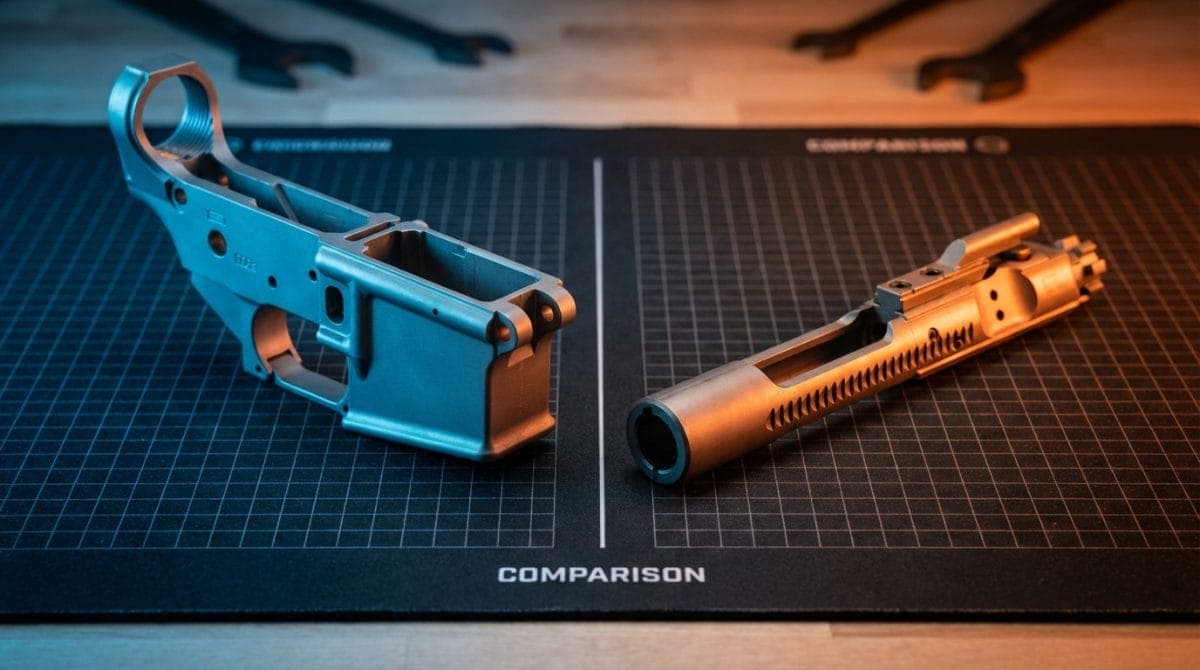
Both cartridges share the same case head diameter (0.378 inches), allowing them to use identical bolts, magazines, and lower receivers. This compatibility makes caliber conversion straightforward: typically, you only need to swap the barrel to switch between these rounds.
Ballistic Performance Analysis
The 5.56 NATO fires lightweight projectiles (typically 55-77 grains) at high velocity. From a 16-inch barrel, a 55-grain bullet achieves approximately 3,100 feet per second (fps). This velocity drops to around 2,750 fps from a 10.5-inch barrel, representing an 11% reduction.
The 300 Blackout round takes a different approach, launching heavier bullets (110-220 grains) at lower velocities. A 125-grain supersonic load achieves roughly 2,215 fps from a 16-inch barrel, dropping to only 2,050 fps from a 9-inch barrel: just a 7% velocity loss.
Energy Retention at Distance
At 300 yards, a 55-grain 5.56 bullet retains approximately 60% of its initial energy (around 700 ft-lbs from a 16-inch barrel). The same distance sees a 125-grain 300 Blackout supersonic load retaining about 55% of its energy (roughly 650 ft-lbs).
Beyond 300 yards, the 5.56’s superior ballistic coefficient typically provides better performance. At 500 yards, 5.56 maintains approximately 450 ft-lbs of energy, while 300 Blackout drops to around 350 ft-lbs.
Barrel Length Considerations
Barrel length dramatically affects cartridge performance, but not equally. The 5.56 NATO relies heavily on barrel length for powder burn and velocity. Testing shows:
- 20-inch barrel: 3,240 fps with 55-grain ammo
- 16-inch barrel: 3,100 fps (4% loss)
- 14.5-inch barrel: 2,990 fps (8% loss)
- 10.5-inch barrel: 2,750 fps (15% loss)
The 300 Blackout demonstrates superior performance from shorter barrels:
- 16-inch barrel: 2,215 fps with 125-grain supersonic
- 10-inch barrel: 2,080 fps (6% loss)
- 9-inch barrel: 2,050 fps (7% loss)
- 8-inch barrel: 2,000 fps (10% loss)
This efficiency makes 300 Blackout ideal for short barrel rifles and pistol builds where 5.56 performance degrades significantly.
Suppressor Performance
The ability to suppress effectively sets these cartridges apart. While both can use suppressors, 300 Blackout offers unique advantages with subsonic ammunition.
Subsonic 300 Blackout loads (typically 190-220 grains at 1,050 fps) eliminate the sonic crack entirely when paired with a suppressor. This results in sound levels around 125-130 decibels at the shooter’s ear, comparable to a pneumatic nail gun.
The 5.56 NATO cannot achieve true subsonic performance while maintaining useful terminal ballistics. Even suppressed, supersonic 5.56 produces 135-140 decibels due to the sonic crack, regardless of suppressor quality.
Terminal Ballistics and Effectiveness
For home defense applications, both calibers prove effective within typical engagement distances (under 50 yards). The 5.56 relies on fragmentation and yaw for terminal effect, requiring velocities above 2,500 fps for reliable fragmentation with standard M193 ammunition.
The heavier bullet weight of 300 Blackout provides different terminal characteristics. Supersonic loads expand reliably at velocities above 1,800 fps, maintaining effectiveness to approximately 150 yards from short barrels. Subsonic loads rely primarily on bullet weight and expansion design rather than velocity-dependent fragmentation.
Penetration Characteristics
Interior wall penetration tests using typical residential construction materials show:
- 5.56 NATO (55-grain): Penetrates 12-14 inches of ballistic gelatin after passing through two sheets of drywall
- 300 Blackout supersonic (125-grain): Penetrates 16-18 inches after similar barrier
- 300 Blackout subsonic (220-grain): Penetrates 14-16 inches after barrier
Both cartridges will penetrate multiple interior walls, making shot placement and backstop awareness important for home defense scenarios.
Ammunition Availability and Cost
Ammunition cost and availability significantly impact long-term ownership. Current market analysis shows:
5.56 NATO pricing (per round):
- Steel case practice: $0.35-0.45
- Brass case FMJ: $0.50-0.65
- Premium defensive: $0.90-1.50
300 Blackout pricing (per round):
- Supersonic FMJ: $0.70-0.90
- Subsonic FMJ: $0.85-1.10
- Premium defensive: $1.20-2.00
The 5.56 NATO benefits from widespread military adoption, resulting in greater availability and typically 30-40% lower cost per round for practice ammunition.
Recoil and Shootability
Recoil impulse differs between cartridges but remains manageable in both cases. Using a standard 6.5-pound rifle:
- 5.56 NATO (55-grain): Approximately 3.8 ft-lbs of recoil energy
- 300 Blackout supersonic (125-grain): Approximately 4.3 ft-lbs
- 300 Blackout subsonic (220-grain): Approximately 3.5 ft-lbs
Most shooters find the difference negligible, though subsonic 300 Blackout produces the softest recoil impulse, beneficial for suppressed shooting or recoil-sensitive shooters.
Detailed Comparison Table
| Characteristic | 5.56 NATO | 300 Blackout |
|---|---|---|
| Bullet Weight Range | 40-77 grains | 110-220 grains |
| Muzzle Velocity (16″ barrel) | 3,100 fps (55gr) | 2,215 fps (125gr supersonic) |
| Muzzle Energy (16″ barrel) | 1,170 ft-lbs | 1,360 ft-lbs |
| Effective Range | 500-600 yards | 300-400 yards |
| Optimal Barrel Length | 14.5-20 inches | 8-16 inches |
| Suppressor Performance | Good (supersonic only) | Excellent (subsonic option) |
| Cost per Round (FMJ) | $0.50-0.65 | $0.70-0.90 |
| Magazine Compatibility | Standard AR-15 | Standard AR-15 |
| Bolt Compatibility | Standard AR-15 | Standard AR-15 |
Military and Professional Use
Understanding military adoption provides insight into real-world performance. The 5.56 NATO serves as the primary rifle cartridge for NATO forces, proving its effectiveness across diverse environments and engagement distances.
Special operations units, including Navy SEALs, have adopted 300 Blackout for specific missions. Its performance from short barrels and superior suppression capabilities make it ideal for close quarters combat and stealth operations. However, 5.56 remains the primary caliber for conventional forces due to logistics and versatility.
Practical Use Case Recommendations
Choose 5.56 NATO for:
- General purpose rifles: Maximum versatility and ammunition availability
- Competition shooting: Flatter trajectory benefits precision at distance
- Budget-conscious training: Lower ammunition costs enable more practice
- Long-range engagement: Superior performance beyond 300 yards
- Standard length rifles: 14.5-inch and longer barrels maximize cartridge potential
Choose 300 Blackout for:
- Short barrel rifles: Optimal performance from 8-10 inch barrels
- Suppressed shooting: Subsonic capability provides Hollywood-quiet operation
- Home defense SBRs: Effective terminal ballistics from compact platforms
- Hunting medium game: Heavier bullets provide better penetration under 200 yards
- Vehicle-based rifles: Shorter overall length with maintained effectiveness
Build Considerations and Component Selection
When building an AR-15 in either caliber, component selection affects reliability and performance. For 5.56 NATO builds, gas system length becomes important with shorter barrels. A 10.5-inch barrel typically requires a carbine-length gas system, while 14.5-inch and longer barrels benefit from mid-length systems for smoother operation.
The 300 Blackout functions reliably with pistol-length gas systems on barrels from 8-16 inches. This standardization simplifies parts selection. However, adjustable gas blocks prove valuable for tuning between supersonic and subsonic loads, particularly for suppressed use.
Making Your Decision
The choice between 300 Blackout and 5.56 ultimately depends on your primary use case. For a first AR-15 or general-purpose rifle, 5.56 NATO provides the best combination of performance, cost, and versatility. Its widespread adoption ensures ammunition availability and extensive aftermarket support.
Choose 300 Blackout when specific requirements favor its strengths: maximum suppression, short barrel performance, or subsonic capability. Many enthusiasts eventually own both, starting with 5.56 for its practicality and adding 300 Blackout for specialized applications.
Recommended Parts for Your Build
Ready to start your build? The AR15 Outfitters Builder helps you configure compatible components for either caliber. Key considerations include:
For 5.56 NATO builds:
- Barrel length: 14.5-18 inches for optimal velocity
- Gas system: Mid-length for 14.5-16 inch barrels
- Twist rate: 1:7 or 1:8 for bullet weight versatility
- Muzzle device: A2 flash hider or effective brake
For 300 Blackout builds:
- Barrel length: 8-10.5 inches for compactness
- Gas system: Pistol-length with adjustable gas block
- Twist rate: 1:7 or 1:8 for heavy subsonic stability
- Muzzle device: Direct thread or QD suppressor mount
Remember that both calibers share magazines, lower receivers, and most upper receiver components. This commonality allows future caliber swaps with minimal investment, making either choice a solid foundation for your AR-15 platform journey.
Disclaimer: AR15 Outfitters does not sell firearms. This site is an information and affiliate resource only. All purchases are completed through licensed retailers. Always comply with all federal, state, and local laws when building or purchasing firearms and firearm components.
More Articles
AR-15 Failure to Eject: Causes and Fixes. Find the best parts and prices on the AR15 Outfitters builder.
AR-15 Failure to Feed: Causes and FixesAR-15 Failure to Feed: Causes and Fixes. Find the best parts and prices on the AR15 Outfitters builder.
AR-15 Double Feed: How to Clear and PreventAR-15 Double Feed: How to Clear and Prevent. Find the best parts and prices on the AR15 Outfitters builder.