
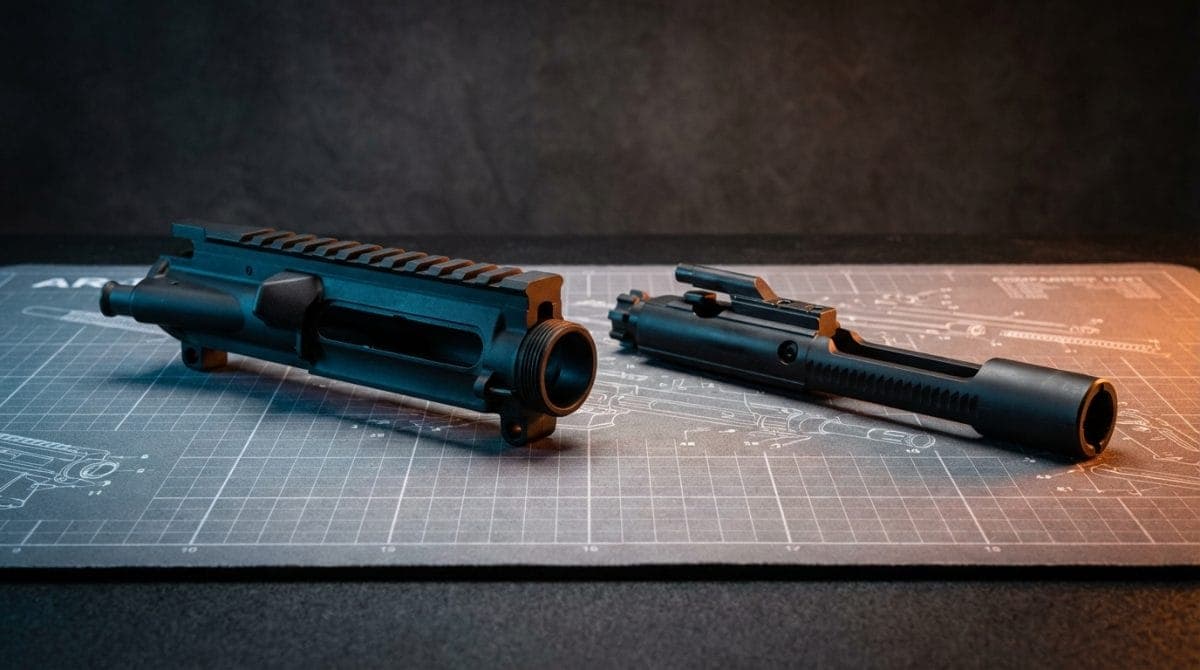
Understanding AR-15 Calibers: 5.56 vs .223 vs .300 Blackout
By AR-15 Outfitters · April 9, 2026
AR15 Outfitters may earn a commission on purchases made through links in this article. This does not affect pricing or our recommendations.
Choosing the right caliber for your AR-15 build is one of the most important decisions you’ll make. While the platform supports dozens of calibers, three dominate the market: 5.56 NATO, .223 Remington, and .300 Blackout. Each offers distinct advantages, and understanding their differences will help you select the best option for your specific needs.
Understanding Chamber Pressure: 5.56 NATO vs .223 Remington
The relationship between 5.56 NATO and .223 Remington often confuses new AR-15 builders. While these cartridges appear nearly identical, their chamber pressure specifications differ significantly.
5.56 NATO operates at higher chamber pressures than .223 Remington. The 5.56 NATO specification allows for approximately 62,000 PSI, while .223 Remington is loaded to around 55,000 PSI. This 7,000 PSI difference becomes important when selecting barrels and understanding ammunition compatibility.
The chamber dimensions also vary slightly. A 5.56 NATO chamber features a longer throat (leade) of approximately 0.125 inches, compared to the .223 Remington’s 0.085-inch throat. This additional space accommodates the higher pressure and allows for reliable feeding of military ammunition, including tracer and armor-piercing rounds.
Safety considerations: You can safely fire .223 Remington ammunition in a 5.56 NATO chamber. However, firing 5.56 NATO ammunition in a .223 Remington chamber can generate dangerously high pressures, potentially causing case ruptures, damaged extractors, or worse. When in doubt, check your barrel markings and stick to appropriate ammunition.
The .223 Wylde Solution
Bill Wylde developed the .223 Wylde chamber to bridge the gap between 5.56 NATO and .223 Remington. This hybrid chamber design combines the best features of both specifications, allowing safe use of either ammunition type while optimizing accuracy.
The .223 Wylde chamber uses the external dimensions of the 5.56 NATO chamber but incorporates a tighter throat design similar to .223 Remington. The throat measures approximately 0.090 inches, splitting the difference between the two parent chambers. This design maintains the pressure-handling capability needed for 5.56 NATO ammunition while providing the tighter tolerances that enhance accuracy with .223 Remington loads.
Many precision and competition shooters prefer .223 Wylde barrels because they typically produce groups 0.25 to 0.5 MOA tighter than standard 5.56 NATO chambers when using match-grade .223 Remington ammunition. The trade-off is minimal: .223 Wylde barrels cost only marginally more than standard chambers.
Ballistic Performance Comparison
Understanding the ballistic characteristics of each caliber helps determine their suitability for different applications. Let’s examine how 5.56/.223 and .300 Blackout perform in real-world conditions.
5.56 NATO and .223 Remington Ballistics
From a 16-inch barrel, a standard 55-grain 5.56 NATO M193 load achieves approximately 3,100 feet per second (fps) muzzle velocity. The same barrel firing 62-grain M855 “green tip” ammunition produces around 2,900 fps. These high velocities translate to flat trajectories and excellent performance at medium ranges.
Energy retention remains impressive out to 300 yards. A 55-grain bullet retains approximately 650 foot-pounds of energy at this distance, while 62-grain projectiles maintain around 700 foot-pounds. The lightweight bullets shed velocity quickly beyond 400 yards, but within typical engagement distances, 5.56/.223 delivers consistent terminal performance.
.300 Blackout Ballistics
The .300 Blackout operates on entirely different principles. Designed to maximize performance from short barrels while maintaining compatibility with standard AR-15 components, this caliber prioritizes bullet weight over velocity.
Supersonic .300 Blackout loads typically use 110 to 125-grain bullets. From a 16-inch barrel, a 125-grain load achieves approximately 2,200 fps. While slower than 5.56, the heavier bullet delivers comparable energy: roughly 1,350 foot-pounds at the muzzle versus 1,250 foot-pounds for 55-grain 5.56.
Subsonic .300 Blackout loads, usually featuring 200 to 220-grain bullets, travel at approximately 1,050 fps from a 16-inch barrel. These loads excel when paired with suppressors, producing minimal noise while delivering 480 to 530 foot-pounds of energy.
Effective Range Analysis
Each caliber’s effective range depends on the intended application and shooter skill level. Let’s examine practical range limitations for different scenarios.
5.56 NATO/.223 Remington Range
For precision target shooting, 5.56/.223 remains effective to 600 yards in skilled hands. Wind drift becomes the primary limiting factor, as the light bullets are susceptible to crosswind deflection. At 500 yards with a 10 mph crosswind, expect approximately 30 inches of drift with 55-grain bullets.
Hunting applications typically limit effective range to 200-300 yards, depending on game size. The light, fast bullets perform best on varmints and predators. For deer-sized game, many states require minimum caliber sizes that exclude .223-class cartridges.
In defensive scenarios, 5.56/.223 provides reliable terminal performance out to 200 yards, with most engagements occurring well inside 100 yards where the caliber truly shines.
.300 Blackout Range
The .300 Blackout trades long-range capability for close to medium-range effectiveness. Supersonic loads maintain hunting-effective velocities to approximately 300 yards, though the rainbow trajectory requires careful holdover calculations beyond 200 yards.
Subsonic .300 Blackout limits practical range to 100-150 yards. The heavy bullets drop dramatically: expect 30 inches of drop at 200 yards compared to just 8 inches with 5.56. However, within its intended envelope, subsonic .300 Blackout delivers impressive terminal performance with minimal noise signature.
Ammunition Cost and Availability
Budget considerations often drive caliber selection for high-volume shooters. The price differential between these calibers can significantly impact training frequency and overall shooting enjoyment.
.223 Remington typically offers the lowest cost per round, with bulk FMJ ammunition available for $0.35 to $0.45 per round during normal market conditions. Steel-cased options from manufacturers like Wolf and Tula can reduce costs to $0.30 per round or less.
5.56 NATO ammunition costs slightly more, typically $0.05 to $0.10 per round above comparable .223 Remington loads. Military surplus ammunition occasionally provides cost savings, though availability fluctuates based on government contract overruns.
.300 Blackout commands premium prices, with supersonic loads averaging $0.60 to $0.80 per round for practice ammunition. Subsonic ammunition costs even more, often exceeding $1.00 per round. The limited production volume and specialized nature of .300 Blackout keep prices elevated compared to .223/5.56.
Availability follows similar patterns. Every gun store stocks .223/5.56, while .300 Blackout selection varies considerably. Rural areas may have limited options, particularly for subsonic loads.
Barrel Requirements and Specifications
Each caliber requires specific barrel configurations for optimal performance. Understanding these requirements helps avoid compatibility issues during your build.
5.56/.223 Barrel Specifications
Standard 5.56/.223 barrels use a bore diameter of 0.219 inches with groove diameter of 0.224 inches. Twist rates vary based on intended bullet weights:
- 1:9 twist: Stabilizes bullets up to 69 grains, ideal for 55-62 grain ammunition
- 1:8 twist: Handles bullets from 55 to 77 grains, the most versatile option
- 1:7 twist: Stabilizes heavy bullets up to 80 grains, standard military specification
Gas system length significantly impacts reliability and recoil. For 16-inch barrels, mid-length gas systems with 9-inch gas tubes provide optimal dwell time of approximately 7.1 inches. Carbine-length systems work but increase bolt velocity and parts wear.
.300 Blackout Barrel Specifications
.300 Blackout barrels share the same external dimensions as 5.56/.223 barrels but feature a larger bore. The 0.308-inch bore requires different rifling specifications:
- 1:8 twist: Optimal for supersonic loads, adequate for most subsonic ammunition
- 1:7 twist: Preferred for subsonic loads, especially 220+ grain bullets
Most .300 Blackout barrels use pistol-length gas systems regardless of barrel length. The larger bore and heavier bullets generate sufficient pressure for reliable cycling even with short gas systems. This standardization simplifies builds and ensures compatibility with various ammunition types.
Magazine Compatibility
One advantage of these calibers is their magazine compatibility, though each has specific considerations for reliable feeding.
Standard AR-15 magazines work with all three calibers, as .300 Blackout uses the same case head dimensions as 5.56/.223. However, feeding reliability varies:
5.56/.223 magazines function flawlessly with their intended ammunition. The straight-walled case design and optimal magazine geometry ensure consistent feeding across all quality levels.
.300 Blackout introduces complications due to its shorter, fatter case design. While standard magazines work, some combinations of bullets and magazines may experience feeding issues. Magpul PMAGs generally provide the best reliability with .300 Blackout, particularly Generation 3 models. The wider feed lips accommodate the different cartridge geometry better than some aluminum magazines.
Magazine capacity remains identical across calibers. A 30-round 5.56 magazine holds 30 rounds of .300 Blackout. However, the significantly different cartridge appearance helps prevent dangerous mix-ups. Always verify your ammunition before loading magazines, as firing .300 Blackout in a 5.56 barrel will cause catastrophic failure.
Caliber Selection for Specific Use Cases
Matching caliber choice to intended use ensures optimal performance and satisfaction with your AR-15 build.
Home Defense Applications
For home defense, both calibers offer viable solutions with different trade-offs. 5.56/.223 with appropriate ammunition (like 55-grain soft points or 77-grain OTM) provides excellent terminal performance while minimizing over-penetration through walls compared to buckshot or pistol calibers.
Subsonic .300 Blackout shines in home defense when paired with a suppressor. The reduced noise protects hearing in indoor environments while heavy bullets deliver fight-stopping performance. Without a suppressor, supersonic .300 Blackout offers similar terminal ballistics to 5.56 but with increased ammunition costs.
Target Shooting and Competition
Competitive shooters overwhelmingly choose 5.56/.223 for its flat trajectory, low recoil, and affordable ammunition. The wide selection of match-grade loads allows tailoring ammunition to specific rifles and competitions. High-volume practice remains economically feasible with bulk ammunition options.
.223 Wylde chambers dominate precision rifle competitions where accuracy takes precedence over ammunition flexibility. The tighter chamber dimensions consistently produce sub-MOA groups with quality ammunition.
Hunting Applications
.300 Blackout expands hunting opportunities compared to 5.56/.223. The heavier bullets and larger diameter create wound channels suitable for deer-sized game within reasonable ranges. Many states that prohibit .223 for deer hunting allow .300 Blackout.
For varmint and predator hunting, 5.56/.223 excels. The flat trajectory simplifies range estimation on small targets, while explosive terminal performance from lightweight bullets provides clean kills on prairie dogs, coyotes, and similar game.
Caliber Comparison Table
| Specification | 5.56 NATO | .223 Remington | .300 Blackout |
|---|---|---|---|
| Chamber Pressure | 62,000 PSI | 55,000 PSI | 55,000 PSI |
| Typical Bullet Weight | 55-77 grains | 55-77 grains | 110-220 grains |
| Muzzle Velocity (16″ barrel) | 3,100 fps (55gr) | 3,050 fps (55gr) | 2,200 fps (125gr supersonic) |
| Effective Range | 600 yards | 600 yards | 300 yards (supersonic) |
| Cost per Round (FMJ) | $0.40-0.55 | $0.35-0.45 | $0.60-0.80 |
| Barrel Twist Rate | 1:7 to 1:9 | 1:8 to 1:12 | 1:7 to 1:8 |
| Suppressor Performance | Good | Good | Excellent (subsonic) |
| Magazine Compatibility | Standard AR-15 | Standard AR-15 | Standard AR-15 |
Making Your Caliber Decision
For most AR-15 builders, 5.56 NATO or .223 Wylde chambers provide the best overall value. The combination of affordable ammunition, excellent ballistic performance, and widespread availability makes these calibers ideal for general-purpose rifles. Choose 5.56 NATO for maximum ammunition flexibility or .223 Wylde for enhanced accuracy potential.
.300 Blackout fills specific niches exceptionally well. If you plan to run a suppressor, hunt medium game, or need maximum performance from a short barrel, .300 Blackout justifies its higher operating costs. The caliber particularly excels in PDW-style builds with barrels under 10 inches.
Consider building multiple uppers to enjoy the benefits of different calibers on the same lower receiver. This approach provides maximum flexibility while sharing common components like triggers, stocks, and grips.
Recommended Parts
Selecting quality components ensures reliable function regardless of chosen caliber. Start your build with a properly chambered barrel from reputable manufacturers like Criterion, Faxon, or Ballistic Advantage. These companies offer barrels in all three chamber specifications with various lengths and profiles.
Match your bolt carrier group to your intended use. Standard mil-spec BCGs work perfectly for all three calibers, though enhanced models with improved coatings can ease maintenance for high-volume shooters. Ensure proper headspacing by purchasing matched barrel and bolt combinations when possible.
Quality magazines prevent feeding issues. Magpul PMAGs, Lancer L5AWMs, and USGI-specification aluminum magazines all provide reliable feeding with proper maintenance. Buy multiple magazines to test different ammunition types and identify any compatibility issues.
Disclaimer: AR15 Outfitters does not sell firearms. This site is an information and affiliate resource only. All purchases are completed through licensed retailers. Always comply with all federal, state, and local laws when building or purchasing firearms and firearm components.
More Articles
AR-15 Failure to Eject: Causes and Fixes. Find the best parts and prices on the AR15 Outfitters builder.
AR-15 Failure to Feed: Causes and FixesAR-15 Failure to Feed: Causes and Fixes. Find the best parts and prices on the AR15 Outfitters builder.
AR-15 Double Feed: How to Clear and PreventAR-15 Double Feed: How to Clear and Prevent. Find the best parts and prices on the AR15 Outfitters builder.