
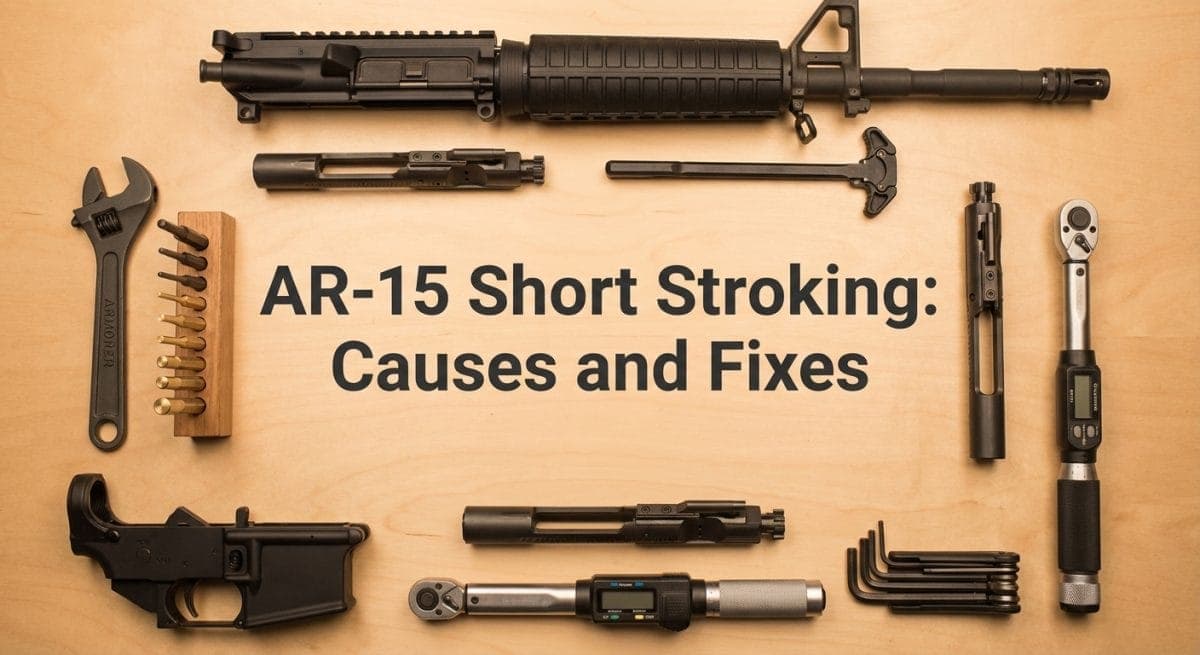
AR-15 Short Stroking: Causes and Fixes
By AR-15 Outfitters · April 10, 2026
AR15 Outfitters may earn a commission on purchases made through links in this article. This does not affect pricing or our recommendations.
Short stroking in an AR-15 occurs when the bolt carrier group (BCG) doesn’t travel far enough rearward to complete a full cycle. This malfunction prevents the rifle from ejecting spent brass, stripping the next round from the magazine, or locking the bolt back on an empty magazine. Understanding the root causes and systematic troubleshooting approach will help you diagnose and fix this common issue.
Understanding the AR-15 Gas System and Short Stroke Mechanics
The AR-15 operates on a direct impingement gas system where gas pressure drives the bolt carrier rearward. When you fire a cartridge, expanding gases travel through the gas port in the barrel, up the gas tube, and into the gas key on the BCG. This pressure pushes the carrier back against the buffer spring.
For proper cycling, the BCG needs to travel approximately 3.875 inches rearward to:
- Extract and eject the spent casing
- Cock the hammer
- Compress the buffer spring fully
- Allow the magazine spring to push the next round into position
- Strip and chamber the next round on forward travel
Short stroking disrupts this sequence when insufficient gas pressure or mechanical resistance prevents full BCG travel.
The Root of Every Cycling Problem
At its core, short stroking results from an imbalance in the gas system equation. Your AR needs sufficient gas pressure to overcome:
- BCG mass (typically 11.5-12 ounces for standard carriers)
- Buffer weight (2.9-5.4 ounces depending on type)
- Buffer spring tension (17-19 pounds when compressed)
- Friction from fouling or inadequate lubrication
When gas pressure falls below this threshold, the bolt won’t complete its cycle. This can manifest as failure to eject, failure to feed, or the bolt not locking back on empty magazines.
The Four Most Common Failures
1. Gas Block Alignment Issues
Misaligned gas blocks account for approximately 40% of short stroke problems. The gas block must align precisely with the gas port in the barrel. Even a 0.010″ misalignment can reduce gas flow by 25-30%.
Symptoms:
- Consistent short stroking across all ammo types
- Brass ejecting at 1-2 o’clock (weak ejection)
- New builds that never cycled properly
Fix: Remove the handguard and verify gas block alignment. The gas block’s port should center perfectly over the barrel’s gas port. Use a 0.070″ drill bit or alignment pin through the gas block to check alignment.
2. Gas Tube Problems
Gas tubes can become bent, crimped, or improperly seated in the gas key. A kinked gas tube reduces gas flow by up to 50%.
Symptoms:
- Gradual onset of cycling issues
- Visible damage to gas tube
- Gas key shows carbon buildup around tube junction
Fix: Inspect the gas tube for straightness using a straight edge. The tube should slide smoothly into the gas key without binding. Replace if bent or crimped.
3. Undergassed Barrel Configuration
Some barrels feature undersized gas ports, particularly in lightweight or “low profile” designs. Standard gas port sizes are:
| Gas System Length | Typical Port Diameter | Barrel Length |
|---|---|---|
| Pistol | 0.120-0.125″ | 7-10″ |
| Carbine | 0.062-0.070″ | 14.5-16″ |
| Mid-length | 0.076-0.078″ | 16-18″ |
| Rifle | 0.086-0.093″ | 20″+ |
Fix: Measure gas port diameter with pin gauges. If undersized, a qualified gunsmith can enlarge the port in 0.003″ increments.
4. BCG and Gas Key Issues
Loose gas keys cause significant gas leakage. The gas key should be secured with Grade 8 screws torqued to 35-40 inch-pounds and properly staked.
Symptoms:
- Carbon buildup around gas key base
- Visible movement when wiggling gas key
- Brass barely clearing ejection port
Fix: Check gas key tightness and staking. Replace gas rings if you can stand the bolt on its head and it falls under its own weight.
The First Three Things to Check
Before diving into complex diagnostics, check these three items that solve 75% of short stroking issues:
1. Verify Your Ammo
Not all ammunition generates equal pressure. Steel-cased ammo typically produces 10-15% less pressure than brass-cased ammunition. Start troubleshooting with quality brass-cased ammo like Federal XM193 or PMC Bronze.
2. Check the Gas Block Set Screws
Loose set screws allow the gas block to shift, creating intermittent short stroking. Apply medium-strength threadlocker and torque set screws to 30 inch-pounds.
3. Inspect Buffer and Spring
An overly heavy buffer or extra-power spring increases resistance beyond what your gas system can overcome. Standard carbine buffers weigh 2.9 ounces; H1 buffers weigh 3.8 ounces. Try a lighter buffer if running suppressed or with low-pressure ammo.
Reading Your Ejection Pattern
Ejection patterns provide diagnostic clues about gas system health:
- 3 o’clock ejection: Properly gassed system
- 1-2 o’clock ejection: Undergassed, weak extraction
- 4-5 o’clock ejection: Overgassed system
- Erratic pattern: Inconsistent gas pressure, check for leaks
Test ejection patterns at 10 feet from a wall using consistent ammunition. Mark where brass hits with tape to identify patterns.
Systematic Troubleshooting Process
Step 1: Establish a Baseline
Document your current setup:
- Barrel length and gas system length
- Buffer weight and spring type
- BCG weight (standard or lightweight)
- Ammunition type and grain weight
Step 2: Single-Round Function Test
Load one round in the magazine. Fire and observe:
- Does the bolt lock back?
- How far does brass eject?
- Is the next round partially fed?
If the bolt doesn’t lock back on empty, you’re definitely undergassed.
Step 3: Progressive Component Testing
Test each variable systematically:
- Try different ammunition (start with M193 spec)
- Remove one tungsten weight from H-buffer
- Replace buffer spring with standard carbine spring
- Clean and inspect BCG thoroughly
- Verify gas block alignment
The Buffer: Your Most Accessible Tuning Tool
Buffer weight significantly impacts cycling reliability. The standard progression is:
| Buffer Type | Weight | Best Use Case |
|---|---|---|
| Carbine | 2.9 oz | 14.5-16″ barrels, standard pressure |
| H (Heavy) | 3.8 oz | 16″ barrels, mid-pressure loads |
| H2 | 4.6 oz | Overgassed systems, suppressed use |
| H3 | 5.4 oz | Full-auto, heavily overgassed |
For short stroking issues, moving down one buffer weight typically provides enough additional dwell time for reliable cycling. Each weight reduction increases bolt velocity by approximately 8-10%.
Advanced Diagnostics with an Adjustable Gas Block
Installing an adjustable gas block provides precise diagnostic capability. Quality adjustable blocks like the SLR Rifleworks Sentry or Superlative Arms models offer:
- Incremental gas flow adjustment
- Ability to tune for specific loads
- Suppressed/unsuppressed settings
- Diagnostic tool for identifying gas system issues
Start with the gas block fully open, then close incrementally until short stroking occurs. This identifies your minimum gas requirement. Open 2-3 clicks beyond this point for reliability margin.
Suppressed Use: Adjust the Gas, Not the Barrel
Suppressors increase backpressure dramatically, often 30-50% more gas pressure. However, some suppressor designs or mounting systems can cause short stroking by:
- Creating turbulent gas flow at the muzzle
- Requiring specific barrel profiles
- Adding reciprocating mass (direct thread)
For suppressed short stroking:
- Verify suppressor alignment with alignment rod
- Check suppressor mounting surface for carbon buildup
- Reduce buffer weight one level
- Consider an adjustable gas block for dual-use guns
300 Blackout: A Special Case
300 Blackout presents unique challenges due to its wide pressure range between supersonic and subsonic loads. Subsonic 300 BLK generates approximately 40% less pressure than supersonic loads.
Typical solutions for 300 BLK short stroking:
- Pistol-length gas systems (4″ gas tube) for 8-10″ barrels
- 0.120-0.125″ gas ports (larger than 5.56)
- Carbine buffer maximum for subsonic reliability
- Adjustable gas block strongly recommended
Component Wear and Maintenance
Regular maintenance prevents short stroking issues:
Every 500 Rounds:
- Clean gas tube with pipe cleaners
- Inspect gas key tightness
- Clean carbon from bolt tail
Every 2,000 Rounds:
- Replace gas rings (3-pack costs $5-8)
- Check buffer spring free length (should be 10.5-11.5″)
- Verify gas block hasn’t shifted
Every 5,000 Rounds:
- Consider buffer spring replacement
- Inspect gas key staking
- Check barrel gas port for erosion
When Professional Help is Needed
Contact a qualified gunsmith when:
- Gas port needs enlargement
- Gas key requires restaking
- Multiple issues exist simultaneously
- Short stroking persists after basic troubleshooting
Building for Reliability: Preventing Short Stroking
When building a new AR-15, prevent short stroking by:
- Matching gas system to barrel length: Use carbine-length for 10.5-14.5″, mid-length for 14.5-18″, rifle-length for 18″+
- Selecting quality barrels: Reputable manufacturers like Criterion, BCM, and Daniel Defense properly size gas ports
- Starting with standard buffers: You can always add weight, but starting heavy limits tuning options
- Using quality gas blocks: Low-profile steel blocks from BCM, Geissele, or SLR provide reliable gas seal
Recommended Parts for Reliable Cycling
Build your AR-15 with components proven to prevent short stroking issues. Visit the AR15 Outfitters Builder to configure your rifle with these recommended parts:
Gas Blocks:
- Fixed: BCM Low Profile Gas Block – bombproof reliability at 0.750″ journal
- Adjustable: Superlative Arms Adjustable – bleed-off design prevents gas tube erosion
Buffers and Springs:
- Standard Use: BCM Carbine Buffer Kit – includes proper weight buffer and spring
- Tuning Options: Spikes Tactical T2 Buffer – tungsten powder allows fine weight adjustment
Bolt Carrier Groups:
- Budget: Toolcraft Nitride BCG – properly staked gas key, correct gas ring gaps
- Premium: BCM Enhanced BCG – redesigned cam pin path for smoother operation
Barrels with Proper Gas Ports:
- 16″ Carbine: Ballistic Advantage Modern Series – 0.750″ journal, properly sized ports
- 16″ Midlength: Criterion Core Series – optimal gas port sizing for mid-length systems
The AR15 Outfitters Builder automatically checks compatibility between components and suggests proven combinations for reliable cycling. Use the gas system length filter to ensure proper matching between barrel length and gas system.
Conclusion
Short stroking typically stems from insufficient gas pressure or excessive resistance in the operating system. By understanding the gas system fundamentals and following systematic troubleshooting steps, most issues can be resolved without professional intervention. Start with simple solutions like checking
Disclaimer: AR15 Outfitters does not sell firearms. This site is an information and affiliate resource only. All purchases are completed through licensed retailers. Always comply with all federal, state, and local laws when building or purchasing firearms and firearm components.
More Articles
AR-15 Failure to Eject: Causes and Fixes. Find the best parts and prices on the AR15 Outfitters builder.
AR-15 Failure to Feed: Causes and FixesAR-15 Failure to Feed: Causes and Fixes. Find the best parts and prices on the AR15 Outfitters builder.
AR-15 Double Feed: How to Clear and PreventAR-15 Double Feed: How to Clear and Prevent. Find the best parts and prices on the AR15 Outfitters builder.