
AR-15 vs AR-10: Complete Comparison
By AR-15 Outfitters · April 9, 2026
AR15 Outfitters may earn a commission on purchases made through links in this article. This does not affect pricing or our recommendations.
The AR-15 and AR-10 represent two of the most popular rifle platforms in America, but choosing between them requires understanding their fundamental differences. While both rifles share the same direct impingement operating system and modular design philosophy pioneered by Eugene Stoner at Armalite in the 1950s, they serve distinctly different purposes. This comprehensive comparison examines the technical specifications, performance characteristics, and practical applications of each platform to help you make an informed decision.
What is The AR-15?
The AR-15 is a lightweight, semi-automatic rifle originally developed by Armalite in 1956. Chambered primarily in 5.56 NATO (.223 Remington), this rifle has become the most popular rifle platform in the United States. The standard AR-15 typically weighs between 6.5 to 8.5 pounds unloaded and features a 16-inch barrel for civilian models, though barrel lengths from 10.5 to 20 inches are common.
Key specifications include:
- Overall length: 32.5 to 36 inches (16-inch barrel with standard stock)
- Magazine capacity: Standard 30 rounds (10, 20, and 40-round magazines available)
- Effective range: 400-600 yards depending on barrel length and ammunition
- Muzzle velocity: 3,100 fps (55-grain 5.56 NATO from 16-inch barrel)
- Recoil impulse: Approximately 4 ft-lbs
What is The AR-10?
The AR-10 predates the AR-15, having been developed by Armalite in 1955. This larger-frame rifle fires full-power cartridges, most commonly .308 Winchester (7.62x51mm NATO). Modern AR-10s typically weigh 8.5 to 11 pounds unloaded and feature longer barrels to maximize the ballistic potential of their more powerful cartridge.
Key specifications include:
- Overall length: 38 to 42 inches (18-inch barrel with standard stock)
- Magazine capacity: Standard 20 rounds (10 and 25-round magazines available)
- Effective range: 800-1000 yards with proper optics and ammunition
- Muzzle velocity: 2,750 fps (168-grain .308 Winchester from 18-inch barrel)
- Recoil impulse: Approximately 15-18 ft-lbs
AR-10 vs. AR-15: What’s Different?
Size and Weight Differences
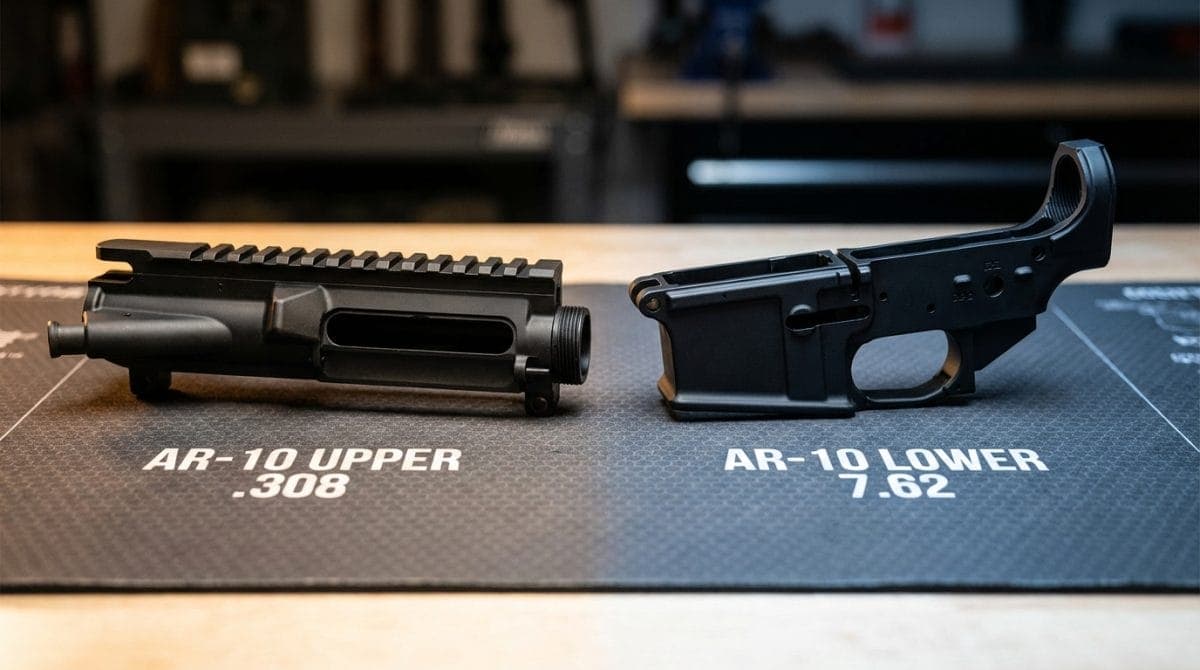
The most immediately noticeable difference between these platforms is their physical size. The AR-10’s receiver set measures approximately 8.3 inches in length compared to the AR-15’s 7.5 inches. This translates to:
- AR-10 upper receiver: 1.338 inches wide at the ejection port
- AR-15 upper receiver: 0.940 inches wide at the ejection port
- Weight difference: Typically 2-3 pounds heavier for comparable AR-10 builds
Caliber and Ballistics
The fundamental difference lies in their chambering. The AR-15 fires intermediate cartridges while the AR-10 handles full-power rifle rounds:
AR-15 common chamberings:
- 5.56 NATO / .223 Remington (most common)
- .300 Blackout
- 6.5 Grendel
- .224 Valkyrie
AR-10 common chamberings:
- .308 Winchester / 7.62x51mm NATO (most common)
- 6.5 Creedmoor
- .243 Winchester
- .338 Federal
At 500 yards, a 77-grain 5.56 NATO round from an AR-15 retains approximately 850 ft-lbs of energy, while a 168-grain .308 from an AR-10 maintains about 1,450 ft-lbs: nearly 70% more energy on target.
Recoil Comparison
The AR-15 produces significantly less recoil than its larger counterpart. In practical terms:
- AR-15 (5.56 NATO): 4-5 ft-lbs of recoil energy
- AR-10 (.308 Winchester): 15-18 ft-lbs of recoil energy
This 3-4x increase in recoil affects follow-up shot speed and shooter fatigue. Most shooters can maintain sub-MOA groups with an AR-15 through a 50-round course of fire, while AR-10 accuracy typically degrades after 20-30 rounds due to fatigue.
AR-10 vs. AR-15: What’s The Same?
Despite their differences, these rifles share numerous design elements:
- Operating system: Both use direct impingement or piston-driven systems
- Manual of arms: Identical safety, magazine release, and charging handle operation
- Trigger group: Many AR-15 triggers fit AR-10 lower receivers
- Furniture compatibility: Stocks, grips, and most handguards are interchangeable
- Modularity: Both platforms support easy barrel and upper receiver swaps
AR-10 vs. AR-15 Parts Compatibility
Understanding parts compatibility helps builders avoid costly mistakes. Here’s what transfers between platforms:
Interchangeable parts:
- Trigger assemblies (in most cases)
- Safety selectors
- Pistol grips
- Buttstocks (with appropriate buffer tube)
- Gas blocks (if diameter matches)
- Muzzle devices (if thread pitch matches)
Non-interchangeable parts:
- Bolt carrier groups
- Barrels
- Upper and lower receivers
- Magazines
- Buffer and buffer spring
- Charging handles
- Handguards (platform-specific mounting)
Comparing The AR-10 And The AR-15: Detailed Analysis
| Specification | AR-15 | AR-10 |
|---|---|---|
| Weight (typical) | 6.5-8.5 lbs | 8.5-11 lbs |
| Standard Caliber | 5.56 NATO | .308 Winchester |
| Magazine Capacity | 30 rounds standard | 20 rounds standard |
| Effective Range | 400-600 yards | 800-1000 yards |
| Recoil Energy | 4-5 ft-lbs | 15-18 ft-lbs |
| Ammo Cost (per round) | $0.35-0.50 | $0.75-1.25 |
| Barrel Life | 15,000-30,000 rounds | 5,000-10,000 rounds |
Benefits and Applications of AR-10s and AR-15s
AR-15 Advantages
The AR-15 excels in scenarios requiring:
- High volume shooting: Lower ammo costs ($0.35-0.50 per round vs $0.75-1.25)
- Minimal recoil: Faster follow-up shots and reduced shooter fatigue
- Home defense: Less overpenetration risk with proper ammunition selection
- Lightweight builds: Sub-6-pound builds achievable for competition use
- Parts availability: Wider selection and generally lower costs
AR-10 Advantages
The AR-10 platform provides:
- Extended range: Effective engagement beyond 500 yards
- Superior terminal performance: Better penetration and energy retention
- Hunting capability: Suitable for deer, elk, and other large game
- Barrier penetration: Better performance through intermediate obstacles
- Wind resistance: Heavier bullets drift less at distance
Is an AR-10 better than an AR-15?
Neither rifle is inherently “better”: each excels in specific applications. The AR-15 typically proves superior for:
- Home defense (with appropriate ammunition)
- Competition shooting (3-gun, USPSA)
- High-volume training
- Smaller game hunting (coyote, varmint)
The AR-10 generally performs better for:
- Long-range precision shooting
- Medium to large game hunting
- Tactical applications requiring barrier penetration
- Situations where maximum terminal effectiveness matters most
Why did the AR-10 fail?
The original AR-10 didn’t commercially fail but lost the U.S. military trials to the M14 in 1957. Factors included:
- Aluminum/steel barrel issues in early prototypes
- Limited production capacity at Armalite
- Military preference for traditional wood-stocked rifles
- Timing: the lighter 5.56mm cartridge concept emerged shortly after
Modern AR-10s have addressed these historical issues and enjoy strong civilian market success.
Are AR-10s worth it?
AR-10s justify their higher cost (typically $200-500 more than comparable AR-15s) when:
- You need engagement capability beyond 600 yards
- Hunting medium to large game is a primary use
- Maximum terminal performance is required
- You reload ammunition (component availability for .308)
Consider total ownership costs: .308 ammunition typically costs 2-3x more than 5.56 NATO, significantly impacting training expenses.
Is a 308 an AR-10 or AR-15?
A .308 Winchester rifle built on the AR platform is an AR-10, not an AR-15. The AR-15’s smaller frame cannot accommodate the .308’s 2.8-inch overall length. Some manufacturers use proprietary names (SR-25, LR-308), but these are AR-10 pattern rifles.
Practical Recommendations
Choose an AR-15 when:
- Budget consciousness matters (lower initial and ongoing costs)
- You prioritize low recoil and fast follow-up shots
- Most engagements will occur within 400 yards
- Home defense is a primary consideration
- You want maximum parts availability and customization options
Choose an AR-10 when:
- Long-range precision is important
- Hunting larger game is planned
- Barrier penetration might be necessary
- You have experience managing heavier recoil
- Ammunition cost is a secondary consideration
Ready to Build an AR-15 or AR-10?
Whether you’ve decided on the versatile AR-15 or the powerful AR-10, building your own rifle ensures you get exactly what you want. The modularity of the AR platform makes assembly straightforward with proper guidance and quality components.
Recommended Parts
Start your build with confidence using the AR15 Outfitters builder tool. Our configurator helps you:
- Ensure parts compatibility across manufacturers
- Compare prices from multiple retailers
- Track your build progress and budget
- Access detailed assembly guides
- Find the best deals on quality components
Visit ar15outfitters.com/builder to start configuring your perfect AR-15 or AR-10 build. The tool automatically checks compatibility between components and alerts you to any potential issues before you purchase.
Both the AR-15 and AR-10 platforms offer exceptional modularity, reliability, and performance when built with quality parts. Understanding their differences helps you select the right tool for your specific needs, whether that’s a lightweight AR-15 for home defense and training or a hard-hitting AR-10 for long-range precision and hunting applications.
Disclaimer: AR15 Outfitters does not sell firearms. This site is an information and affiliate resource only. All purchases are completed through licensed retailers. Always comply with all federal, state, and local laws when building or purchasing firearms and firearm components.
More Articles
AR-15 Failure to Eject: Causes and Fixes. Find the best parts and prices on the AR15 Outfitters builder.
AR-15 Failure to Feed: Causes and FixesAR-15 Failure to Feed: Causes and Fixes. Find the best parts and prices on the AR15 Outfitters builder.
AR-15 Double Feed: How to Clear and PreventAR-15 Double Feed: How to Clear and Prevent. Find the best parts and prices on the AR15 Outfitters builder.