
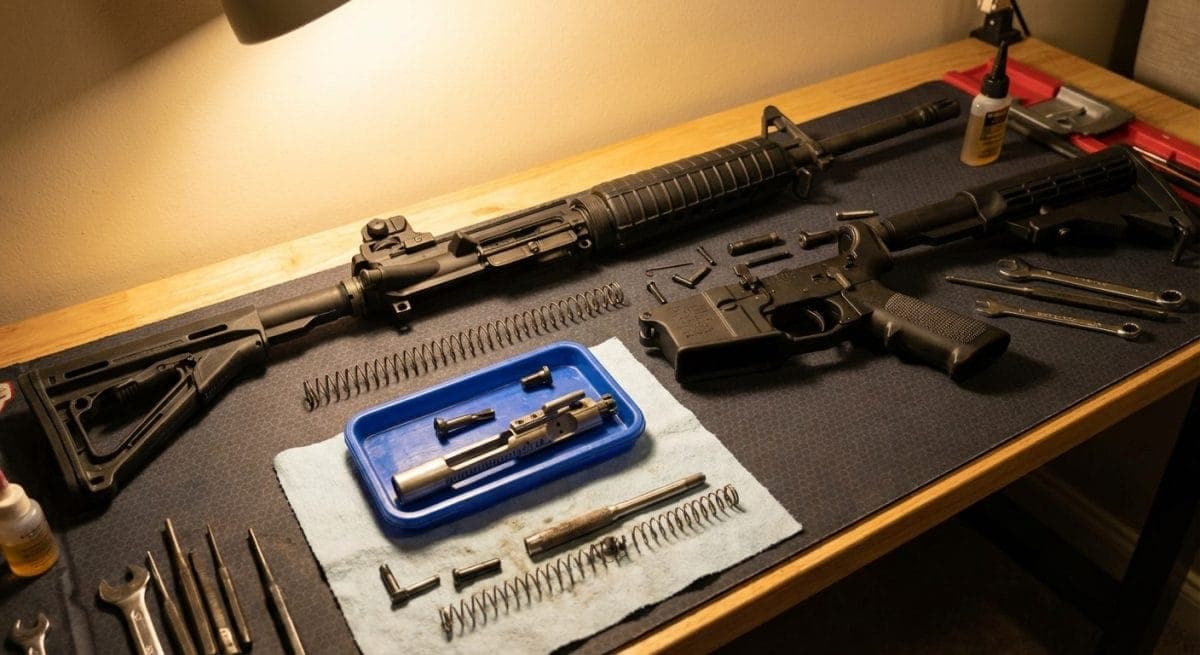
AR-15 Won’t Cycle: Troubleshooting Guide
By AR-15 Outfitters · April 10, 2026
AR15 Outfitters may earn a commission on purchases made through links in this article. This does not affect pricing or our recommendations.
When your AR-15 won’t cycle properly, it transforms from a reliable rifle into a frustrating single-shot. Whether you’re experiencing failure to feed, failure to eject, or short stroking, systematic troubleshooting will help you identify and fix the problem. This guide walks through the most common cycling issues and their solutions, helping you get your AR back to reliable operation.
Understanding the AR-15 Cycling Process
Before diving into troubleshooting, it’s important to understand how your AR cycles. When you pull the trigger, the firing pin strikes the primer, igniting the powder charge. As the bullet travels down the barrel, gas pressure builds behind it. Some of this gas bleeds through the gas port into the gas block and gas tube, traveling back to push the bolt carrier group rearward.
The bolt carrier needs sufficient momentum to:
- Unlock from the barrel extension
- Extract the spent casing
- Eject the empty brass
- Compress the buffer spring
- Strip a new round from the magazine
- Chamber the fresh cartridge
- Lock back into battery
A malfunction at any point disrupts this cycle. Most cycling problems stem from insufficient or excessive gas pressure, mechanical issues, or ammunition problems.
Reading Your Ejection Pattern
Your brass ejection pattern provides valuable diagnostic information about your gas system. Stand at the firing line and note where casings land relative to your rifle:
- 3 o’clock ejection: Ideal gas system tuning
- 1-2 o’clock ejection: Overgassed system
- 4-5 o’clock ejection: Undergassed system
- Forward ejection: Severely overgassed
- Weak dribbling ejection: Severely undergassed
Consistent ejection patterns typically indicate proper function, while erratic patterns suggest timing or mechanical issues.
Common AR-15 Cycling Malfunctions
Failure to Extract
When the bolt fails to pull the spent casing from the chamber, you’ll find an empty case still seated when you manually cycle the charging handle. Common causes include:
- Worn or broken extractor spring (replace every 5,000 rounds)
- Carbon buildup on extractor
- Out-of-spec ammunition with oversized rim diameter
- Insufficient gas pressure to fully unlock the bolt
Failure to Eject
The infamous “stovepipe” occurs when the bolt extracts the casing but fails to clear it from the ejection port. The case gets caught between the bolt and upper receiver. This typically results from:
- Weak or damaged ejector spring
- Undergassed system providing insufficient BCG velocity
- Overly heavy buffer slowing bolt carrier speed
- Limp-wristing (yes, it affects rifles too)
Short Stroking
Short stroking happens when the bolt carrier doesn’t travel far enough rearward to pick up the next round. The bolt locks back on an empty chamber despite rounds in the magazine. Primary causes:
- Undergassed system from incorrectly sized gas port
- Gas block misalignment (should be centered over gas port)
- Obstructed gas tube
- Buffer too heavy for gas system length
Bolt Override
Less common but equally frustrating, bolt override occurs when the BCG passes over the next cartridge without stripping it from the magazine. This typically indicates:
- Magazine sitting too low due to worn catch
- Out-of-spec magazine body
- Damaged feed lips allowing rounds to sit too low
Systematic Troubleshooting Procedure
When diagnosing cycling issues, follow this systematic approach:
Step 1: Check Your Ammunition
Start with the simplest variable. Underpowered ammunition is a leading cause of cycling problems. Steel-cased ammunition typically generates 10-15% less pressure than brass. If your rifle cycles brass but not steel, you’re likely undergassed. Try different ammunition brands and bullet weights to establish a baseline.
Step 2: Inspect the BCG
Remove your bolt carrier group and inspect:
- Gas rings: All three should be intact with gaps staggered at 120-degree intervals
- Bolt lugs: Check for cracks or excessive wear
- Extractor tension: Should provide firm grip on a dummy round
- Ejector function: Should spring back smoothly when depressed
Step 3: Verify Gas System Alignment
Remove your handguard to inspect the gas block. The gas block must be perfectly centered over the barrel’s gas port. Even 0.010″ misalignment can cause cycling issues. Use a 0.073″ drill bit (for 0.750″ journals) to verify alignment through the gas block port.
Step 4: Test Buffer System
Your buffer weight must match your gas system length:
| Gas System | Barrel Length | Typical Buffer Weight |
|---|---|---|
| Pistol | 7-11.5″ | H2 (4.6-4.7 oz) |
| Carbine | 14.5-16″ | Carbine (3.0 oz) or H (3.8 oz) |
| Mid-Length | 16-18″ | Carbine (3.0 oz) |
| Rifle | 20″ | Rifle (5.0 oz) |
If you’re running suppressed, typically increase buffer weight by one step to manage increased backpressure.
Advanced Diagnostics
Single-Round Testing
Load one round in the magazine. Fire and observe:
- Does the bolt lock back on the empty magazine?
- Where did the casing eject?
- Any signs of primer cratering or ejector swipe?
If the bolt doesn’t lock back, you’re undergassed. If you see excessive ejector marks or primer flow, you’re likely overgassed.
Gas Port Measurement
For persistent issues, measure your gas port diameter. Typical specifications:
- Pistol gas: 0.093-0.125″ depending on barrel length
- Carbine gas: 0.063-0.078″
- Mid-length gas: 0.076-0.081″
- Rifle gas: 0.093-0.096″
Ports at the smaller end work well with full-power ammunition but may struggle with weak loads. Larger ports provide reliability with various ammunition at the cost of increased wear.
Solutions for Common Issues
Undergassed Systems
If testing confirms insufficient gas:
- Verify gas block alignment first (free fix)
- Try a lighter buffer (Carbine weight instead of H buffer)
- Install an adjustable gas block for fine-tuning
- As a last resort, consider having the gas port enlarged by a gunsmith
Overgassed Systems
For excessive gas pressure:
- Install a heavier buffer (H2 or H3)
- Add an adjustable gas block to reduce gas flow
- Use a heavier buffer spring (Sprinco Blue or similar)
- Consider a captured buffer system for smoother operation
Special Considerations
Suppressed Shooting
Suppressors increase backpressure by 20-40%, often causing overgassing symptoms. Rather than changing your barrel, tune the gas system with an adjustable gas block. This allows quick transitions between suppressed and unsuppressed shooting.
300 Blackout Considerations
300 Blackout presents unique challenges with its wide pressure range between supersonic and subsonic loads. Most 300 BLK barrels use pistol-length gas systems with 0.120-0.125″ gas ports to cycle both load types. An adjustable gas block becomes nearly mandatory for reliable function across the ammunition spectrum.
Recommended Parts
For reliable cycling across various conditions, consider these upgrades:
- BCM Bolt Carrier Group: Properly staked gas key and HPT/MPI tested bolts ensure consistent function
- Superlative Arms Adjustable Gas Block: Bleed-off design prevents carbon lock common in restriction-style blocks
- Sprinco Buffer Springs: Silicon chrome construction maintains consistent pressure across temperature ranges
- BCM Extractor Spring Upgrade Kit: Includes O-ring for enhanced extraction reliability
Build your properly tuned AR-15 using the AR15 Outfitters configurator to ensure component compatibility and optimal cycling performance.
When Professional Help is Needed
Some issues require professional intervention:
- Gas port requires enlarging
- Barrel extension timing issues
- Receiver damage or out-of-spec dimensions
- Persistent problems after systematic troubleshooting
A qualified gunsmith has specialized tools like bore scopes and headspace gauges to diagnose issues beyond typical user-level troubleshooting.
Preventive Maintenance
Regular maintenance prevents most cycling problems:
- Clean and lubricate BCG every 500-1000 rounds
- Replace extractor and ejector springs every 5,000 rounds
- Inspect gas rings every 1,000 rounds
- Keep gas tube clear of carbon buildup
- Verify gas block remains properly aligned
A properly maintained AR-15 should cycle reliably for thousands of rounds. When problems arise, systematic diagnosis using ejection patterns, single-round testing, and component inspection will identify the issue. Whether you need a simple gas block alignment or buffer weight change, understanding your rifle’s gas system dynamics helps you tune for optimal performance.
Disclaimer: AR15 Outfitters does not sell firearms. This site is an information and affiliate resource only. All purchases are completed through licensed retailers. Always comply with all federal, state, and local laws when building or purchasing firearms and firearm components.
More Articles
AR-15 Failure to Eject: Causes and Fixes. Find the best parts and prices on the AR15 Outfitters builder.
AR-15 Failure to Feed: Causes and FixesAR-15 Failure to Feed: Causes and Fixes. Find the best parts and prices on the AR15 Outfitters builder.
AR-15 Double Feed: How to Clear and PreventAR-15 Double Feed: How to Clear and Prevent. Find the best parts and prices on the AR15 Outfitters builder.