
Can You Ship AR-15 Parts to Your Door?
By AR-15 Outfitters · April 10, 2026
AR15 Outfitters may earn a commission on purchases made through links in this article. This does not affect pricing or our recommendations.
Building an AR-15 at home offers flexibility and customization that many firearm enthusiasts appreciate. However, understanding what can be shipped directly to your door versus what requires an FFL transfer is essential for staying compliant with federal law. This guide breaks down exactly which AR-15 parts you can order online and receive at home, which components must be shipped to an FFL dealer, and the specific requirements that govern these regulations.
Understanding FFL Requirements for AR-15 Parts
The distinction between parts that can be shipped to your home and those requiring FFL transfers centers on one key component: the lower receiver. Under federal law, the lower receiver is legally considered the firearm itself, even though it’s just one part of the complete rifle. This classification means that while you can order most AR-15 components online and have them delivered to your doorstep, the lower receiver must follow the same regulations as purchasing any other firearm.
The ATF (Bureau of Alcohol, Tobacco, Firearms and Explosives) established this framework because the lower receiver contains the fire control group and serial number. It’s the only part of an AR-15 that requires serialization, making it the regulated component that tracks ownership and transfers.
Parts That Can Ship Directly to Your Home
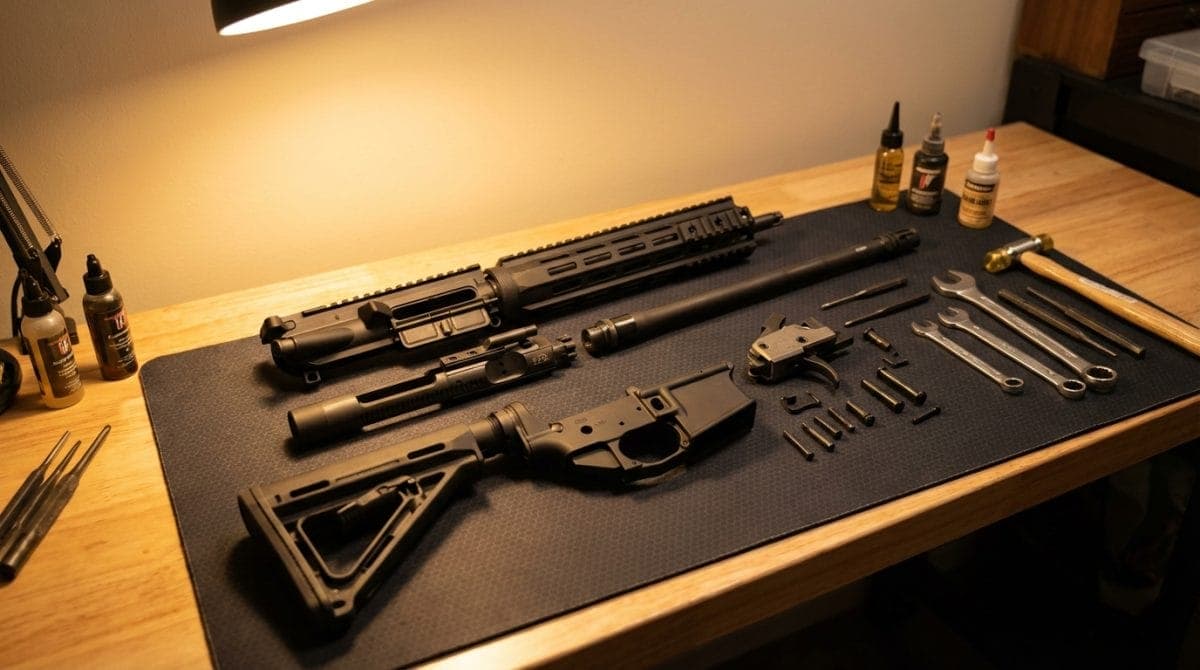
The vast majority of AR-15 components can be shipped directly to your residential address without any FFL involvement. These include:
- Complete upper receivers: Despite containing the barrel and bolt carrier group, upper receivers are not considered firearms under federal law
- Barrels: All barrel lengths, including those under 16 inches for pistol builds
- Bolt carrier groups: Both standard and enhanced models
- Handguards and rail systems: Free-float, drop-in, and quad rail varieties
- Stocks and pistol braces: Adjustable, fixed, and stabilizing braces
- Triggers and fire control parts: Single-stage, two-stage, and drop-in trigger units
- Lower parts kits: Everything except the lower receiver itself
- Magazines: Subject to state and local law restrictions on capacity
- Optics and sights: Red dots, scopes, iron sights
- Muzzle devices: Flash hiders, compensators, and brakes
Parts Requiring FFL Transfer
Only a few AR-15 components require shipping to an FFL dealer:
- Complete lower receivers: Whether stripped or assembled
- 80% lower receivers: Once completed beyond 80%, these become firearms
- Registered drop-in auto sears: NFA items requiring additional ATF approval
- Complete firearms: Fully assembled AR-15 rifles or pistols
When is an FFL Needed?
An FFL transfer becomes necessary whenever you’re purchasing a serialized lower receiver or complete firearm. This requirement applies whether you’re buying from an online retailer, at a gun show, or through a private sale (in states that mandate background checks for private transfers). The process typically works as follows:
- Select your lower receiver or complete firearm online
- Choose an FFL dealer near you (most online retailers maintain FFL finder tools)
- Complete your purchase with the FFL dealer’s information
- The seller ships the item to your chosen FFL
- Visit the FFL to complete ATF Form 4473 and background check
- Pay the transfer fee (typically $20-75 depending on location)
- Take possession of your lower receiver or firearm
Age restrictions also apply: you must be 18 years old to purchase a rifle lower receiver or 21 years old for a pistol lower receiver. Some FFLs may require you to be 21 years old for any lower receiver purchase due to the potential for pistol configuration.
State-Specific Shipping Restrictions
While federal law provides the baseline for what can be shipped to your home, individual states often impose additional restrictions. Understanding your local law is essential before ordering AR-15 parts online.
States with Additional Restrictions
| State | Additional Restrictions | Key Requirements |
|---|---|---|
| California | Magazine capacity limits, “assault weapon” features | 10-round magazine limit, featureless builds or fixed magazines required |
| New York | SAFE Act compliance, registration requirements | Fixed magazines or featureless builds, 10-round limit |
| Connecticut | Assault weapon ban, magazine restrictions | Pre-ban lowers only, 10-round magazines |
| Massachusetts | Approved roster, feature restrictions | Must be on approved firearms roster, 10-round limit |
| New Jersey | Assault weapon restrictions, magazine limits | Specific feature combinations banned, 10-round limit |
| Maryland | Banned features, registration | Heavy barrel required for certain configurations |
Some states also restrict shipping of specific components. For example, New Jersey prohibits direct shipment of certain parts like flash hiders and folding stocks to consumers. Always verify current state and local laws before ordering.
Carrier-Specific Policies
Different shipping carriers maintain varying policies regarding firearm parts. Understanding these differences helps ensure smooth delivery of your AR-15 components.
UPS Policies
UPS generally accepts non-firearm parts for standard shipping. They require:
- No special labeling for parts (excluding receivers)
- Adult signature typically not required for parts
- Complete firearms and receivers must ship to FFL only
- Next Day Air required for handgun shipments
FedEx Policies
FedEx maintains similar policies with some variations:
- Parts ship via standard service levels
- No firearm-related labeling on packages
- Firearms ship only between licensed entities
- Overnight service required for handguns
USPS Policies
The United States Postal Service has the most restrictive policies:
- Long gun parts generally acceptable
- Handgun parts prohibited for non-licensees
- No handgun shipments except between FFLs
- Rifles can ship between individuals where legal
Building Your First AR-15: Component Shipping Guide
For first-time builders, understanding the shipping process helps streamline your build. Here’s a practical breakdown of ordering components for a typical AR-15 rifle build:
Direct-to-Home Components (First Orders)
Start by ordering these components that ship directly to your door:
- Complete upper receiver assembly: Typically includes barrel, gas system, and handguard ($250-800)
- Lower parts kit: Contains all small parts except lower receiver ($40-150)
- Buffer tube assembly: Includes spring, buffer, and tube ($30-75)
- Stock or brace: Based on your rifle or pistol configuration ($25-200)
- Sights or optics: Iron sights or red dot to start ($50-500)
- Magazines: Start with 3-5 magazines where legal ($10-25 each)
FFL Transfer Component
Order your lower receiver last, after confirming your local FFL’s policies:
- Stripped lower receiver: Requires FFL transfer ($50-200)
- Transfer fee: Budget $20-75 for FFL services
- Background check: May include state fees ($0-50)
Cost Comparison: Direct Shipping vs. FFL Transfers
Understanding the true cost difference between direct shipping and FFL transfers helps with budgeting your build:
| Purchase Method | Typical Costs | Time Frame | Convenience Factor |
|---|---|---|---|
| Direct-to-home parts | $5-20 shipping | 3-7 business days | High: delivered to door |
| FFL transfer (lower) | $20-75 transfer + shipping | 5-10 business days | Medium: requires FFL visit |
| Complete rifle (FFL) | $25-100 transfer + shipping | 7-14 business days | Low: wait times vary |
Factor in these hidden costs for FFL transfers:
- Time off work for pickup during FFL hours
- Travel costs to FFL location
- Potential storage fees if not picked up promptly
- State-specific fees or taxes
80% Lowers: A Special Category
The 80% lower receiver occupies a unique position in AR-15 building. Currently, these unfinished receivers can be shipped directly to your home in most states because they’re not yet considered firearms. However, this landscape is changing:
- Federal definition: Not a firearm until 80% complete
- No serial number required: In most states (check local law)
- Completion requirements: Typically 1-3 hours with proper jig
- Tools needed: Drill press or router, specific jigs ($75-300)
Several states now regulate 80% lowers like complete firearms, including California, Connecticut, New Jersey, and others. The ATF has also proposed rule changes that would affect their classification nationwide.
What Are the Requirements to Get an FFL?
Some builders consider obtaining their own FFL to simplify the process. While not necessary for personal builds, an FFL offers advantages for frequent builders or those interested in the business side:
FFL Application Requirements
- Age: Minimum 21 years old
- Location: Compliant with local zoning laws
- Storage: Secure storage meeting ATF requirements
- Background: Clean criminal record
- Business intent: Must intend to engage in business
- Application fee: $200 for initial 3-year license (Type 07)
- Renewal: $90 every 3 years
Can I Have an FFL at My House?
Yes, home-based FFLs are possible in many areas, but require:
- Local zoning approval for commercial activity
- Separate entrance or dedicated business space preferred
- Secure storage (safe meeting ATF specifications)
- Ability to post required signage
- Willingness to allow ATF inspections
- Compliance with all state and local laws
Practical Build Recommendations
Based on shipping requirements and typical builder needs, here are optimized approaches for different scenarios:
First-Time Builder
- Order all direct-ship parts first (upper, LPK, furniture)
- Confirm function with dummy rounds
- Select and order lower receiver
- Complete FFL transfer while gathering tools
Multiple Builds Per Year
- Establish relationship with local FFL for volume discounts
- Order multiple lowers together to save on transfers
- Consider C&R license for eligible items
- Buy common parts in bulk when on sale
Budget-Conscious Builder
- Compare total costs including FFL fees before ordering
- Look for “transfer day” specials at local FFLs
- Consider complete rifles if transfer fees are high
- Ship multiple items together when possible
Which AR Parts Require FFL?
To summarize clearly, here’s a definitive list of what requires FFL transfer versus direct shipping:
Always Requires FFL
- Stripped lower receivers
- Complete lower receivers
- Complete firearms (rifle or pistol)
- Registered machine gun parts (NFA items)
- Completed 80% receivers
Never Requires FFL (Federal Level)
- Upper receivers (complete or stripped)
- Barrels (any length)
- Bolt carrier groups
- Triggers and hammer groups
- Stocks, grips, and handguards
- Muzzle devices
- Optics and sights
- Magazines (check state laws)
Recommended Parts for Your Build
Ready to start selecting components for your AR-15 build? The AR15 Outfitters Builder Tool helps you configure a complete rifle while checking compatibility and comparing prices across multiple vendors. The builder automatically categorizes parts by shipping requirements, making it easy to see what can be delivered to your door versus what needs FFL transfer.
For a basic rifle build shipping directly to your home (except the lower), consider these component categories available through the builder:
- Upper receiver groups: Choose from hundreds of complete uppers in various calibers and configurations
- Furniture sets: Match your stock, grip, and handguard for consistent aesthetics
- Optics packages: Compare red dots, scopes, and iron sight options
- Lower build kits: Everything except the receiver in one package
The platform tracks real-time
Disclaimer: AR15 Outfitters does not sell firearms. This site is an information and affiliate resource only. All purchases are completed through licensed retailers. Always comply with all federal, state, and local laws when building or purchasing firearms and firearm components.
More Articles
AR-15 Failure to Eject: Causes and Fixes. Find the best parts and prices on the AR15 Outfitters builder.
AR-15 Failure to Feed: Causes and FixesAR-15 Failure to Feed: Causes and Fixes. Find the best parts and prices on the AR15 Outfitters builder.
AR-15 Double Feed: How to Clear and PreventAR-15 Double Feed: How to Clear and Prevent. Find the best parts and prices on the AR15 Outfitters builder.