
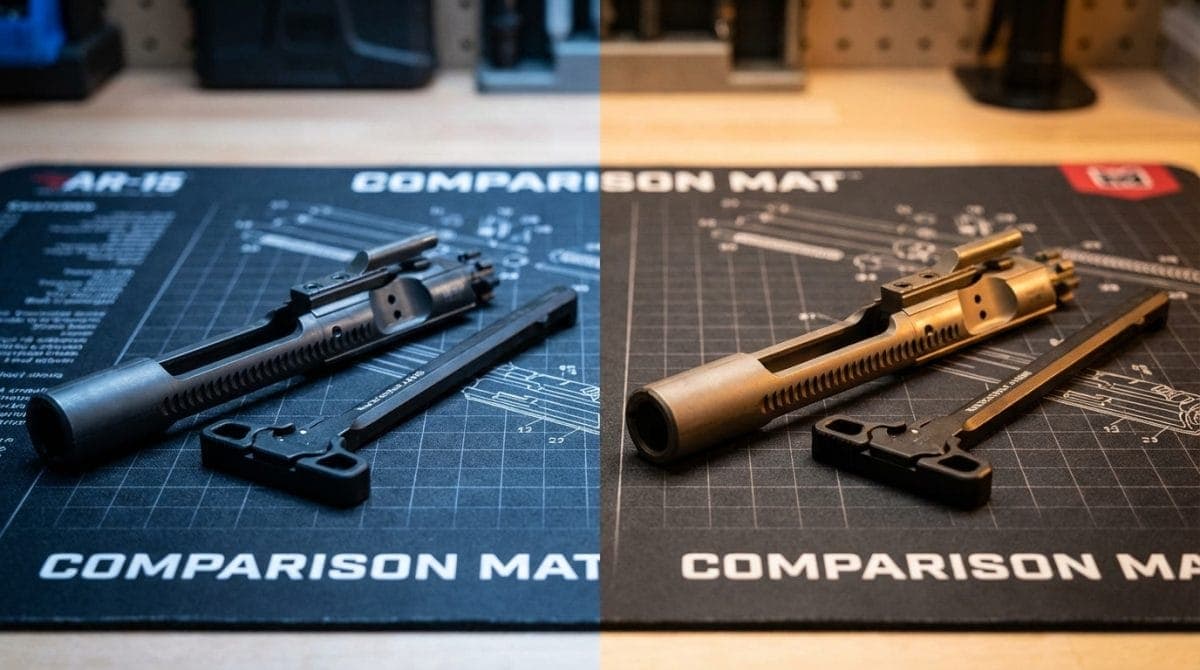
Direct Impingement vs Piston: Pros and Cons
By AR-15 Outfitters · April 9, 2026
AR15 Outfitters may earn a commission on purchases made through links in this article. This does not affect pricing or our recommendations.
When building an AR-15, one of the fundamental decisions you’ll face is choosing between a direct impingement system and a gas piston system. This choice affects everything from reliability and maintenance to weight and cost. Understanding how each operating system works and their respective trade-offs helps you make an informed decision for your specific needs.
What is Direct Impingement and How Does it Work?
The direct impingement system, designed by Eugene Stoner for the original AR-15, remains the most common operating system in modern AR-15 rifles. In this design, gas from the fired cartridge travels through a gas port in the barrel, into the gas block, and then back through a gas tube directly into the bolt carrier group.
When you pull the trigger, expanding gases push the bullet down the barrel. As the bullet passes the gas port (typically located 7 to 9 inches from the chamber), some gas bleeds off into the gas block. This gas travels through the gas tube and enters the bolt carrier through the gas key, expanding inside the carrier and pushing it rearward. This rearward movement unlocks the bolt, extracts the spent case, and cycles the action.
The beauty of direct impingement lies in its simplicity: fewer moving parts mean less weight and fewer potential failure points. A standard direct impingement gas tube weighs approximately 1.1 ounces, while the entire gas system adds only about 3 ounces to the rifle.
The Introduction of the Piston-Driven AR-15
Gas piston systems for the AR platform gained popularity in the early 2000s, borrowing concepts from rifles like the AK-47. Instead of routing gas directly to the bolt carrier, piston systems use gas to drive a piston that mechanically pushes the bolt carrier group rearward.
In a short-stroke piston system (the most common type for AR-15s), gas enters the gas block and pushes against a piston head. This piston strikes an operating rod attached to the bolt carrier, transferring energy to cycle the action. The gas vents near the gas block rather than entering the receiver.
Piston guns typically add 4 to 8 ounces to the rifle’s weight compared to direct impingement, with the complete piston assembly weighing between 6 and 10 ounces depending on the manufacturer.
Comparing Gas Piston vs. Direct Impingement: Pros and Cons
Direct Impingement Advantages
Lightweight Design: Direct impingement AR-15s typically weigh 0.5 to 0.75 pounds less than comparable piston models. This weight savings comes from the simple gas tube replacing the heavier piston assembly.
Parts Commonality: With millions of direct impingement ARs in circulation, replacement parts are readily available. A replacement gas tube costs $15 to $30, while bolt carrier groups range from $75 to $250.
Accuracy Potential: The fixed gas tube creates a more rigid connection between barrel and receiver. Many precision shooters report sub-MOA groups more consistently with direct impingement rifles, though individual results vary.
Cost Effectiveness: Direct impingement rifles typically cost $100 to $400 less than comparable piston models. Budget builds can be completed for under $500, while quality piston systems rarely fall below $800.
Direct Impingement Disadvantages
Carbon Buildup: Hot gases entering the receiver deposit carbon on the bolt carrier group and inside the upper receiver. After 500 to 1,000 rounds, you’ll notice significant fouling requiring cleaning.
Heat Transfer: Gas temperatures of 800 to 1,000 degrees Fahrenheit enter the receiver, heating the bolt carrier group and potentially affecting reliability during extended firing sessions.
Suppressor Considerations: When running suppressed, direct impingement systems increase back pressure and gas blowback into the shooter’s face, particularly with shorter barrels.
Gas Piston Advantages
Cleaner Operation: Piston systems keep combustion gases away from the bolt carrier and receiver. After 2,000 rounds, a piston gun’s bolt carrier group typically shows minimal carbon buildup compared to direct impingement.
Cooler Running: With gas venting at the gas block, the bolt carrier group runs 20 to 30 percent cooler in most cases. This temperature reduction can improve reliability during high-volume shooting.
Suppressor Performance: Piston AR rifles generally produce less gas blowback when suppressed, improving shooter comfort and reducing toxic gas exposure.
Adverse Condition Reliability: Some users report better functioning in sandy or muddy conditions, as the operating system is more isolated from environmental contamination.
Gas Piston Disadvantages
Increased Weight: The piston assembly adds front-end weight, affecting balance and handling. This weight increase is most noticeable during extended carry or precision shooting from unsupported positions.
Proprietary Parts: Each manufacturer uses different piston designs. Replacement parts cost more (typically $150 to $400 for a complete piston assembly) and aren’t universally compatible.
Carrier Tilt: Some piston systems can cause the bolt carrier to tilt during operation, potentially increasing wear on the receiver’s cam pin slot and buffer tube.
Timing Complexity: Gas piston systems require precise timing adjustment, particularly when changing barrel lengths or adding suppressors. Improper timing leads to short-stroking or excessive bolt velocity.
Comparison Table
| Feature | Direct Impingement | Gas Piston |
|---|---|---|
| Weight | Lighter (saves 4-8 oz) | Heavier (adds 4-8 oz) |
| Initial Cost | $500-$1,500 typical | $800-$2,500 typical |
| Parts Availability | Excellent, standardized | Limited, proprietary |
| Maintenance Frequency | Every 500-1,000 rounds | Every 2,000-3,000 rounds |
| Operating Temperature | Higher BCG temps | 20-30% cooler BCG |
| Suppressed Performance | More gas blowback | Less gas blowback |
| Accuracy Potential | Excellent | Good to Excellent |
| Reliability | Proven, requires maintenance | Excellent, less sensitive |
Decide What’s Right for You
Choose Direct Impingement If:
- You’re building on a budget (under $1,000 total build cost)
- Weight is a primary concern for competition or hunting
- You want maximum parts compatibility and availability
- You’re comfortable with regular cleaning and maintenance
- Precision accuracy is your top priority
Choose a Piston System If:
- You primarily shoot suppressed
- You need maximum reliability in adverse conditions
- Minimal maintenance is important to your use case
- You fire high round counts between cleaning sessions
- Budget allows for the additional $200 to $500 cost
Military and Professional Use
The U.S. military primarily uses direct impingement M4 carbines and M16 rifles, though some units have adopted piston variants like the HK416 (used by Navy SEALs and other special operations forces). The military’s continued use of direct impingement demonstrates the system’s reliability when properly maintained.
Law enforcement agencies show mixed preferences, with some favoring piston systems for their reduced maintenance requirements during extended deployments, while others stick with direct impingement for cost and training compatibility.
Practical Recommendations
For most AR-15 builders, direct impingement offers the best balance of cost, weight, and performance. The system’s 60-year track record proves its effectiveness for everything from home defense to competition shooting.
Consider a piston gun if you shoot more than 5,000 rounds annually, regularly use suppressors, or operate in extremely dusty or sandy environments. The reduced maintenance and cooler operation justify the additional cost for high-volume shooters.
Regardless of system choice, quality components matter more than operating system. A well-built direct impingement rifle will outperform a poorly assembled piston gun, and vice versa.
Recommended Parts
Ready to build your own AR-15? Use the AR15 Outfitters Builder Tool to configure your rifle with compatible components. The builder automatically checks part compatibility and compares prices across multiple retailers, ensuring you get the best value for your build.
Whether you choose direct impingement or piston, the builder tool helps you select appropriate gas blocks, tubes or piston kits, and bolt carrier groups designed for your chosen operating system. Start with a lower receiver and work your way up, knowing each component will work together properly.
The choice between direct impingement and gas piston ultimately depends on your specific needs, budget, and shooting habits. Both systems have proven themselves capable in millions of firearms worldwide. Understanding their differences helps you build an AR-15 optimized for your intended use.
Disclaimer: AR15 Outfitters does not sell firearms. This site is an information and affiliate resource only. All purchases are completed through licensed retailers. Always comply with all federal, state, and local laws when building or purchasing firearms and firearm components.
More Articles
AR-15 Failure to Eject: Causes and Fixes. Find the best parts and prices on the AR15 Outfitters builder.
AR-15 Failure to Feed: Causes and FixesAR-15 Failure to Feed: Causes and Fixes. Find the best parts and prices on the AR15 Outfitters builder.
AR-15 Double Feed: How to Clear and PreventAR-15 Double Feed: How to Clear and Prevent. Find the best parts and prices on the AR15 Outfitters builder.