
First Time AR-15 Buyer: What to Know Before You Start
By AR-15 Outfitters · April 10, 2026
AR15 Outfitters may earn a commission on purchases made through links in this article. This does not affect pricing or our recommendations.
Bottom Line Up Front
Your first AR-15 rifle should be a quality complete rifle from a reputable manufacturer in the $600-$1200 range. Focus on these essentials: 16-inch barrel, mid-length gas system, free-float handguard, and a quality bolt carrier group. Skip the accessories initially; invest in training ammunition and range time instead. The AR-15 platform offers unmatched modularity, allowing you to upgrade components as you learn your preferences.
Setting Baselines: Understanding the AR-15 Platform
The AR-15 rifle, developed by Eugene Stoner in the late 1950s, has become America’s most popular sporting rifle. With an estimated 20 million in civilian hands, the AR platform dominates the market for good reasons: exceptional modularity, widespread parts availability, and proven reliability.
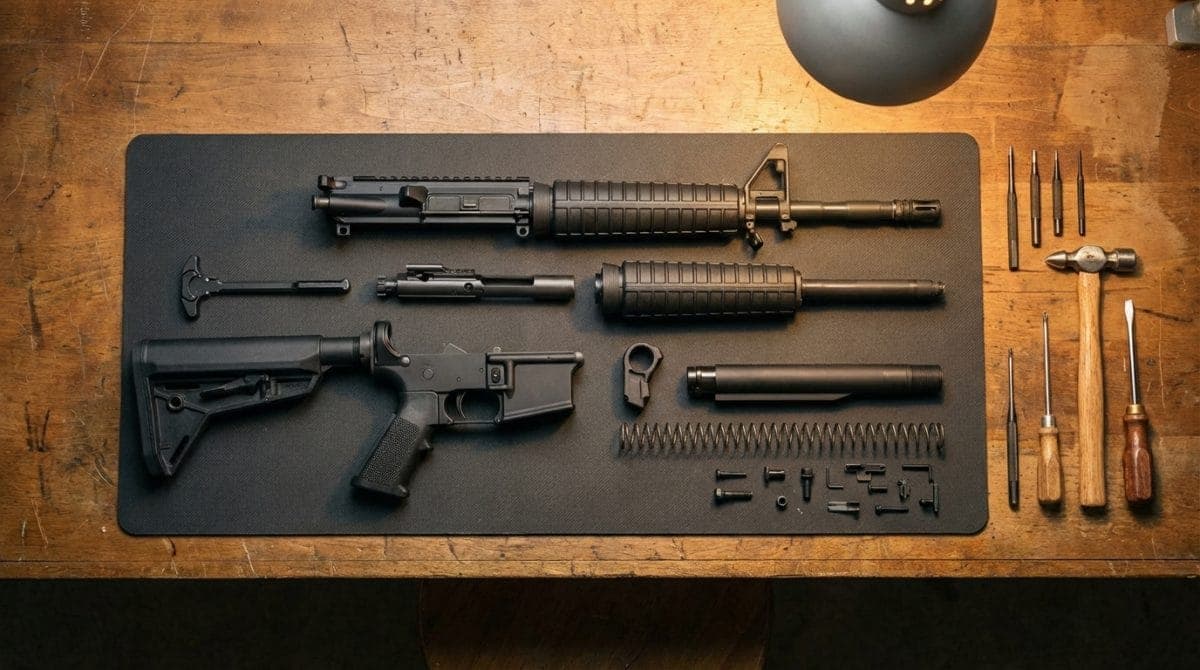
Unlike traditional rifles, the AR-15 separates into two main components: the upper and lower receiver. This design allows builders to swap calibers, barrel lengths, and configurations without purchasing an entirely new gun. For the first time AR-15 buyer, this modularity means your initial purchase can evolve with your skills and needs.
Key Terminology Every Beginner Should Know
Before diving into your first AR-15 purchase, understanding these components helps decode specifications:
- Upper Receiver: Houses the barrel, bolt carrier group (BCG), charging handle, and handguard
- Lower Receiver: Contains the trigger group, magazine well, buffer system, and stock; this is the serialized “firearm” portion
- Gas System Length: Carbine (7 inches), mid-length (9 inches), or rifle length (12 inches)
- Barrel Profile: Government, pencil, or heavy profile affecting weight and heat dissipation
- Twist Rate: How many inches the rifling takes to complete one rotation (typically 1:7, 1:8, or 1:9)
Your First AR-15: Buy Complete or Build?
For beginners, buying a complete rifle offers the best path to ownership. While building an AR-15 provides valuable learning experience, it requires tools, knowledge, and troubleshooting skills that new gun owners typically lack.
Complete Rifle Advantages
- Warranty Coverage: Manufacturers typically provide 1-year to lifetime warranties on complete rifles
- Proper Assembly: Factory torque specifications ensure reliability (barrel nuts torqued to 30-80 ft-lbs, gas blocks properly aligned)
- Immediate Use: No tool investment or assembly time required
- Quality Control: Reputable manufacturers test-fire rifles before shipping
When Building Makes Sense
Consider building only if you:
- Have mechanical aptitude and proper tools (armorer’s wrench, vise blocks, torque wrench)
- Want specific components not available in factory configurations
- Enjoy the building process as much as shooting
- Have experienced builders to guide you
Guiding Principles for Your First AR-15 Purchase
These principles help navigate the overwhelming options when buying your first AR-15:
1. Define Your Primary Use Case
Different uses demand different configurations:
- Home Defense: 14.5-16 inch barrel, weapon light capability, reliable iron sights or red dot
- Target Shooting: 18-20 inch barrel, free-float handguard, match trigger
- General Purpose: 16 inch barrel, mid-length gas, versatile furniture
- Competition: Depends on division; typically 16-18 inch barrel with specialized components
2. Budget Realistically
Your rifle purchase represents only part of the total investment:
| Category | Budget Range | Percentage of Total |
|---|---|---|
| Complete Rifle | $600-$1200 | 40-50% |
| Optic/Iron Sights | $150-$500 | 10-20% |
| Ammunition (1000 rounds) | $400-$600 | 20-25% |
| Magazines (5-10) | $50-$150 | 5-10% |
| Training/Range Fees | $200-$500 | 10-15% |
3. Prioritize Core Components
Focus spending on components that affect reliability and accuracy:
- Bolt Carrier Group: Full-auto rated, properly staked gas key, Carpenter 158 or 9310 bolt material
- Barrel: Chrome-lined or nitrided bore, proper chamber dimensions, reputable manufacturer
- Trigger: Consistent 4.5-6.5 pound single-stage or quality two-stage design
Essential Specifications for First-Time Buyers
Barrel Length and Gas System
The relationship between barrel length and gas system length significantly impacts reliability and shooting comfort:
| Barrel Length | Recommended Gas System | Dwell Time | Characteristics |
|---|---|---|---|
| 10.3-11.5″ | Carbine | 3.3-4.5″ | Loud, increased wear, requires tax stamp |
| 14.5″ | Carbine or Mid | 5.5″ (mid) | Requires pinned muzzle device for 16″ OAL |
| 16″ | Mid-length | 7″ | Best all-around choice, softer recoil |
| 18″ | Mid or Rifle | 6″ (rifle) | Increased velocity, heavier |
| 20″ | Rifle length | 8″ | Maximum velocity, traditional configuration |
For first-time buyers, a 16-inch barrel with mid-length gas system provides the best balance. This configuration offers:
- No NFA restrictions
- Adequate dwell time for reliable function
- Reduced port pressure (typically 12,000-14,000 PSI vs 17,000-19,000 PSI in carbine systems)
- Softer recoil impulse
Caliber Considerations
While the AR platform supports dozens of calibers, beginners should start with 5.56 NATO/.223 Remington:
- Ammunition Cost: $0.40-0.60 per round for quality brass-cased ammunition
- Availability: Found at virtually every gun store and online retailer
- Recoil: Minimal, allowing focus on fundamentals
- Barrel Life: Typically 20,000-30,000 rounds before accuracy degradation
Alternative calibers like .300 Blackout, 6.5 Grendel, or .224 Valkyrie offer specific advantages but cost 50-200% more per round and have limited availability.
Twist Rate Selection
Barrel twist rate determines which bullet weights stabilize properly:
- 1:9 Twist: Stabilizes 45-69 grain bullets; limited to lighter projectiles
- 1:8 Twist: Handles 50-77 grain bullets; versatile middle ground
- 1:7 Twist: Stabilizes 55-80+ grain bullets; military standard, most versatile
Most modern AR-15 rifles feature 1:7 or 1:8 twist rates, both excellent for beginners. The 1:7 twist provides maximum flexibility for ammunition selection.
Critical Components: What Makes a Quality AR-15
Bolt Carrier Group Quality Indicators
The bolt carrier group represents the heart of your AR-15. Quality indicators include:
- Bolt Material: Carpenter 158 steel (mil-spec) or 9310 steel (often superior)
- Testing: High-pressure tested (HPT) and magnetic particle inspected (MPI)
- Gas Key: Properly staked with Grade 8 fasteners torqued to 35-40 inch-pounds
- Coating: Phosphate (mil-spec), nitride, or advanced coatings like nickel boron
Budget BCGs in the $60-80 range often skip testing or use inferior materials. Quality BCGs from manufacturers like BCM, Daniel Defense, or SOLGW typically cost $150-250 but provide peace of mind.
Barrel Manufacturing Methods
Three primary methods produce AR-15 barrels:
- Button Rifled: Most common, good accuracy, moderate cost ($150-300)
- Cold Hammer Forged: Exceptional durability, typically 20% longer life, higher cost ($250-400)
- Cut Rifled: Most precise, slowest production, premium pricing ($300-500+)
For beginners, a quality button-rifled barrel from FN, Criterion, or BA provides excellent accuracy and value.
Trigger Characteristics
Factory triggers typically break between 5.5-8.5 pounds. Key measurements include:
- Take-up: Initial trigger movement before resistance
- Wall: Point where trigger resistance increases
- Break: Point where hammer releases
- Overtravel: Movement after break
- Reset: Forward distance to re-engage sear
Quality mil-spec triggers from ALG Defense or BCM ($50-80) offer significant improvements over basic factory triggers while maintaining reliability.
Recommended First AR-15 Rifles by Budget
Entry Level ($500-$700)
Palmetto State Armory PA-15
- Typical Price: $499-599
- 16″ chrome-lined barrel, 1:7 twist
- Carbine or mid-length gas system
- Basic furniture and sights
- Lifetime warranty
PSA rifles deliver surprising quality at budget prices. While fit and finish won’t match premium brands, core components meet specifications. Many buyers report 5,000+ rounds without malfunctions.
Smith & Wesson M&P15 Sport II
- Typical Price: $650-750
- 16″ barrel, 1:9 twist
- 5R rifling for easier cleaning
- Excellent customer service
- Widely available
Mid-Range ($700-$1000)
Ruger AR-556 MPR
- Typical Price: $800-900
- 18″ cold hammer forged barrel
- Rifle length gas system
- Free-float M-LOK handguard
- 2-stage trigger (4.5 pounds)
The MPR (Multi-Purpose Rifle) includes features typically found on $1200+ rifles. The 18-inch barrel provides approximately 100 fps velocity increase over 16-inch barrels.
Springfield Saint Victor
- Typical Price: $900-1000
- 16″ chrome moly vanadium barrel
- Mid-length gas system
- Enhanced trigger
- Quality BCG included
Premium Entry Options ($1000-$1500)
BCM RECCE-16
- Typical Price: $1300-1400
- 16″ BFH (cold hammer forged) barrel
- Enhanced lightweight profile
- BCM BCG and charging handle
- Exceptional quality control
Daniel Defense DDM4V7
- Typical Price: $1400-1500
- 16″ chrome-lined barrel
- Mid-length gas system
- Ambidextrous controls
- Lifetime guarantee
AR-15 Pistol Considerations for Beginners
While AR pistols offer compactness, they present challenges for new gun owners:
- Legal Complexity: Brace regulations change frequently; current ATF guidance remains unclear
- Increased Blast: 10.5″ barrels produce 165+ dB at shooter’s ear (hearing damage begins at 140 dB)
- Velocity Loss: 5.56 from 10.5″ barrel loses 300-400 fps compared to 16″ barrel
- Reliability Concerns: Shorter dwell time demands quality components
If pursuing an AR pistol, consider:
- 11.5″ barrel minimum for better reliability
- Adjustable gas block for tuning
- Linear compensator to direct blast forward
- Quality ammunition (avoid steel case)
Essential Accessories for Your First AR-15
Optics and Iron Sights
Start with quality iron sights before adding optics. Options include:
- Fixed Front Sight Base: Most durable, provides gas block
Disclaimer: AR15 Outfitters does not sell firearms. This site is an information and affiliate resource only. All purchases are completed through licensed retailers. Always comply with all federal, state, and local laws when building or purchasing firearms and firearm components.
More Articles
AR-15 Failure to Eject: Causes and Fixes. Find the best parts and prices on the AR15 Outfitters builder.
AR-15 Failure to Feed: Causes and FixesAR-15 Failure to Feed: Causes and Fixes. Find the best parts and prices on the AR15 Outfitters builder.
AR-15 Double Feed: How to Clear and PreventAR-15 Double Feed: How to Clear and Prevent. Find the best parts and prices on the AR15 Outfitters builder.