
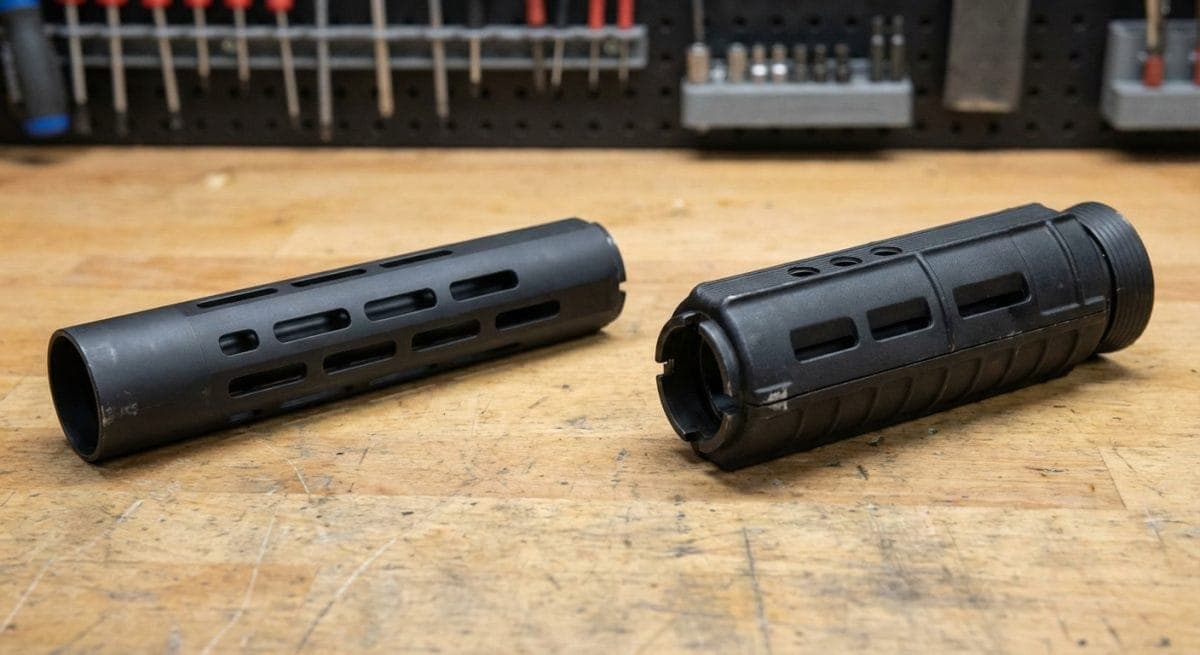
Free Float vs Drop-In Handguards: What to Choose
By AR-15 Outfitters · April 9, 2026
AR15 Outfitters may earn a commission on purchases made through links in this article. This does not affect pricing or our recommendations.
When building or upgrading your AR-15, selecting the right handguard fundamentally shapes your rifle’s performance, handling, and versatility. The choice between free float vs drop in handguard AR-15 options represents one of the most impactful decisions you’ll make, directly affecting accuracy, heat management, and accessory mounting capabilities.
This comparison breaks down the technical differences, real-world performance implications, and cost considerations to help you make an informed choice for your specific needs.
What is a Drop-In Handguard?
Drop-in handguards represent the original AR-15 handguard design, utilizing the existing delta ring and front sight post assembly. These handguards consist of two polymer or aluminum halves that clamp around the barrel, secured by the delta ring spring tension and supported at the front by the handguard cap attached to the front sight base.
The installation process typically takes 5-10 minutes with basic tools: you compress the delta ring, slide in the rear of each handguard half, then snap the front into the handguard cap. This simplicity makes drop-in handguards particularly appealing for first-time AR-15 builders or those seeking quick upgrades.
Drop-In Handguard Components and Function
The system relies on three primary components working together:
- Delta Ring Assembly: Provides spring tension to secure the rear of the handguard, typically requiring 15-20 pounds of force to compress
- Handguard Cap: A triangular or round cap that attaches to the front sight base, supporting the front of the handguard
- Handguard Halves: Two pieces that mate together, often featuring heat shields rated for temperatures up to 500°F
Standard drop-in handguards measure 6.625 inches for carbine-length systems and 9.55 inches for mid-length systems, with the handguard cap positioned 0.25 inches behind the gas block journal.
What is a Free-Floating Handguard?
Free float handguards attach exclusively to the barrel nut, eliminating any contact with the barrel itself. This design principle means external forces applied to the handguard: from slings, bipods, or shooting positions: don’t directly influence barrel harmonics or point of impact.
A free-float handguard system replaces the standard barrel nut with a proprietary mounting system. Installation typically requires 30-45 minutes and involves torquing the barrel nut to 35-80 ft-lbs (depending on manufacturer specifications), timing any required anti-rotation features, and securing the handguard via screws, clamps, or proprietary locking mechanisms.
Free Float Mounting Systems
Modern free-floating handguards employ various mounting approaches:
- Two-piece clamping: Uses 6-8 screws torqued to 25-35 in-lbs to clamp around a proprietary barrel nut
- Direct thread: The handguard itself threads onto the barrel nut, requiring proper timing
- Wedge lock: Utilizes an expanding wedge system for tool-free installation after initial setup
These systems accommodate handguard lengths from 7 inches to 15+ inches, with most featuring M-LOK or KeyMod attachment points spaced at 1.575-inch intervals for accessories.
Key Performance Differences in Free-Float vs Drop-In Handguard Comparison
Accuracy Impact
Testing data from precision rifle shooters consistently demonstrates measurable accuracy improvements with free float handguards. In controlled testing with match-grade ammunition:
- Drop-in handguards: Typical 5-shot groups at 100 yards measure 1.5-2.5 MOA with quality barrels
- Free float handguards: Same rifles typically achieve 0.75-1.5 MOA groups, a 25-50% improvement
This accuracy enhancement becomes more pronounced when shooting from supported positions. Bipod pressure on a drop-in handguard can shift point of impact by 1-3 MOA at 100 yards, while free-floating handguards show minimal to no shift.
Heat Management
Thermal performance varies significantly between designs:
Drop-in handguards with heat shields maintain touchable exterior temperatures (typically below 140°F) even after 90 rounds of rapid fire. However, the enclosed design traps heat around the barrel and gas system, potentially affecting long-term barrel life.
Free float handguards promote better heat dissipation through increased airflow around the barrel. Testing shows barrel temperatures 15-25% lower after extended firing sessions compared to drop-in designs. However, aluminum free float rails can reach 180-220°F at contact points near the gas block after 60 rounds of rapid fire.
Weight and Balance Considerations
Component weights vary considerably:
- Standard polymer drop-in: 4-6 ounces for carbine length
- Quad rail drop-in: 10-14 ounces for carbine length
- Aluminum free float (M-LOK): 7-11 ounces for 9-inch length
- Carbon fiber free float: 4-7 ounces for 9-inch length
Free float handguards typically shift the balance point forward by 0.5-1.5 inches compared to polymer drop-ins, which some shooters prefer for dynamic shooting disciplines.
Detailed Comparison Table
| Feature | Drop-In Handguards | Free Float Handguards |
|---|---|---|
| Installation Time | 5-10 minutes | 30-45 minutes |
| Required Tools | None (hand installation) | Torque wrench, vise, specialized wrenches |
| Accuracy Potential | 1.5-2.5 MOA typical | 0.75-1.5 MOA typical |
| Cost Range | $20-150 | $75-400+ |
| Gas Block Options | FSB required | Any low-profile gas block |
| Maximum Rail Length | Limited by gas system | Up to 15+ inches |
| Accessory Mounting | Limited (requires add-on rails) | Extensive M-LOK/KeyMod slots |
| Barrel Contact | Yes (at front sight base) | No contact |
| Heat Shield Available | Yes (standard) | Limited options |
| Typical Weight | 4-14 oz | 4-16 oz |
Popular Drop-In Handguard Manufacturers
Leading manufacturers have refined the drop-in handguard design with modern materials and features:
- Magpul MOE: Reinforced polymer construction with integrated heat shields, M-LOK slots at 3/6/9 positions, typically $30-40
- BCM: Available in both polymer and aluminum variants, known for superior heat shield design rated to 600°F
- Daniel Defense Omega: Unique free-float-style drop-in quad rail that requires no gunsmithing, $200-250
- Troy Industries: Aluminum drop-in options with integrated flip-up sights, $150-200
Popular Free-Floating Handguard Manufacturers
The free float market offers extensive options across price points:
- Aero Precision: ATLAS series uses a clamping design with anti-rotation tabs, excellent value at $100-150
- Midwest Industries: Combat Rail series features a two-piece clamping system with lifetime warranty, $150-250
- Geissele Automatics: MK series rails use a bombproof mounting system tested to 1,100 ft-lbs of torque, $250-350
- Daniel Defense: RIS II issued to SOCOM, featuring bolted connection to upper receiver, $400-500
How to Choose Between Free-Float vs Drop-In Handguard for Your AR-15
Choose Drop-In Handguards When:
- Budget constraints exist: Total cost including installation tools favors drop-in by $100-200
- Maintaining classic aesthetics: Building a retro or service rifle clone
- Prioritizing simplicity: Field replacement possible without tools
- Using iron sights: Fixed front sight post provides proven durability
- Shooting shorter distances: Accuracy differences minimal inside 200 yards for most shooters
Choose Free Float Handguards When:
- Accuracy matters most: Precision shooting or competition use
- Mounting multiple accessories: Lights, lasers, and grips without added rails
- Using optics exclusively: No need for front sight post
- Building a lightweight rifle: Carbon fiber options available
- Wanting maximum versatility: Ability to change barrel length without handguard limitations
Installation Considerations
Drop-in handguard installation requires minimal expertise, making it ideal for kitchen table builds. The most challenging aspect involves compressing the delta ring, which some find difficult without a specialized tool (though a pair of channel locks wrapped in tape works).
Free float installation demands more preparation:
- Remove existing barrel nut (requires vise and upper receiver block)
- Install new barrel nut with proper torque (typically 35-80 ft-lbs)
- Verify gas tube alignment (critical for function)
- Time any anti-rotation features
- Mount handguard and torque fasteners to specification
First-time installers should budget 60-90 minutes for free float installation, including troubleshooting time.
Do Free Float Handguards Get Hot?
Yes, free float handguards can become uncomfortably hot during extended firing sessions. Without integrated heat shields, aluminum rails conduct heat from the barrel and gas system. After 90 rounds fired over 5 minutes, typical aluminum free float rails measure:
- 160-180°F at 3 inches from chamber
- 140-160°F at 6 inches from chamber
- 120-140°F at 9 inches from chamber
Solutions include rail covers, gloves, or selecting handguards with enhanced ventilation designs. Some manufacturers offer optional heat shields or insulating sleeves.
Which Is Right for You?
For general purpose AR-15 builds where cost-effectiveness and ease of maintenance matter most, quality drop-in handguards from manufacturers like Magpul or BCM provide excellent functionality. They’re particularly well-suited for home defense rifles, patrol carbines, or recreational shooting within 300 yards.
Free float handguards justify their added complexity and cost when accuracy takes priority. Precision shooters, competitors, and those building specialized rifles benefit from the consistency and versatility these systems provide. The ability to mount accessories directly to M-LOK or KeyMod slots without adding weight proves invaluable for tactical applications.
Recommended Parts
Ready to select components for your build? The AR15 Outfitters Builder helps you compare handguard options with real-time pricing from multiple retailers. The configurator ensures compatibility between your chosen handguard, barrel nut, gas system, and other components while finding the best current prices.
Whether you choose the simplicity of drop-in handguards or the performance advantages of free-floating handguards, understanding these fundamental differences ensures your AR-15 build meets your specific shooting requirements and budget constraints.
Disclaimer: AR15 Outfitters does not sell firearms. This site is an information and affiliate resource only. All purchases are completed through licensed retailers. Always comply with all federal, state, and local laws when building or purchasing firearms and firearm components.
More Articles
AR-15 Failure to Eject: Causes and Fixes. Find the best parts and prices on the AR15 Outfitters builder.
AR-15 Failure to Feed: Causes and FixesAR-15 Failure to Feed: Causes and Fixes. Find the best parts and prices on the AR15 Outfitters builder.
AR-15 Double Feed: How to Clear and PreventAR-15 Double Feed: How to Clear and Prevent. Find the best parts and prices on the AR15 Outfitters builder.